About Biberify
The Architecture Of Balance At Biberify
Our search for balance in Biberify’s fermented hot pepper sauce extends from the recipe to a bite’s finish on the palate. We want umami, sour, salty and gently sweet notes and pepper heat to be perceived together while retaining their own characters. The sauce’s relationship with the food is part of that whole.
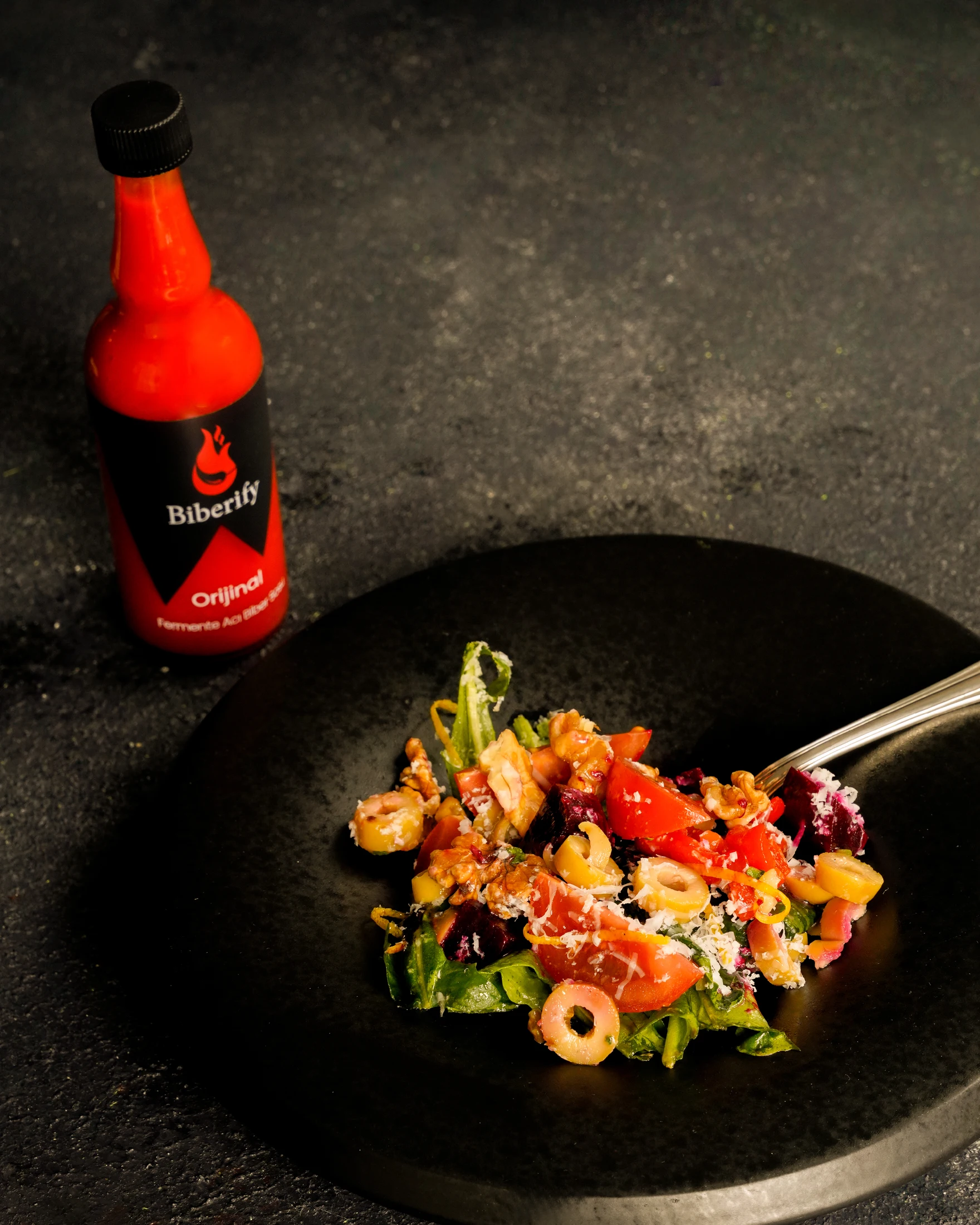
Balance With Pepper At Its Heart
We build the sauce’s base by combining the fermented pepper blend with the other ingredients in the right proportions. The depth of flavour, acidity and umami developed through fermentation accompany pepper heat; the other ingredients complement and deepen these flavours to balance the whole.
This depth of flavour also involves the ingredients’ transformation over time. In lactofermentation, lactic acid bacteria produce lactic acid from sugars; other compounds formed in the process also contribute to taste and aroma. Liu and colleagues compared peppers fermented in different regions of Hunan, examining free amino acids and organic acids alongside volatile aroma compounds and sensory evaluations. Understanding fermented pepper flavour means considering how these different components are perceived together.
Fermentation-derived lactic acid, the liveliness of vinegar and citric acid as a third source together shape the sauce’s acidity. We adjust the balance of all three so that the pepper aroma remains distinct.
We use sea salt in an amount intended to bring flavours forward and strengthen their relationship. We want gently sweet traces from ripe peppers to remain lightly perceptible alongside heat and sourness.
The perceived intensity of tastes can also change when they are combined. In Green and colleagues’ experiments with aqueous taste mixtures at specific concentrations, some tastes were perceived less strongly together than on their own. At Biberify, we approach this relationship by considering how each ingredient affects the other flavours in the blend as well as its own taste. The balance we seek allows the pepper’s character to remain distinct within that combination.
When changing an ingredient’s proportion, we consider thickness, heat, acidity and salt together, seeking richness in how our chosen elements complement one another.
From Texture To Finish
We blend a high proportion of fermented peppers with xanthan gum obtained through fermentation to create the sauce’s thick consistency and full body. By body, we mean the fullness the sauce gives in the mouth. We want the sauce to melt slowly in the mouth and blend with the food.
Appearance in the bottle alone is not enough to assess thickness; the liquid’s resistance to movement in the mouth also matters. Deblais and colleagues compared the flow properties of 14 liquid bouillons with a trained panel’s thickness ratings. By modelling movement between tongue and palate, the study related perceived thickness to the liquid’s resistance to that movement. We likewise think of Biberify’s body beyond how the sauce pours: how it spreads through a bite and becomes part of the food’s texture are qualities we seek in its consistency.
After you swallow a bite, we seek a quick finish that leaves the palate unburdened and makes room for the next bite. Our aim is for the sauce to become part of the food during a bite without leaving a lingering heaviness afterwards, so the next bite allows the food’s aroma and texture, together with the sauce’s flavours, to be perceived afresh.
A First Encounter At The Table
For a first encounter with Biberify, we suggest simple dishes with a distinct character. Tomato and cheese together on a Margherita pizza, focaccia’s olive-oil texture or the grain flavour of whole-wheat blini can offer starting points.
In this tasting, we look for the food’s details alongside the heat. Lyu and colleagues asked 66 participants to evaluate tomato soup, beef burger patties and curried rice at four chilli-powder levels. All four levels contained chilli powder. Increasing chilli produced small reductions in tomato flavour, sweetness and sourness ratings for the soup and in beef-flavour ratings for the patties. They found no significant differences in the rice’s studied taste and flavour attributes, in overall flavour intensity across the three foods, or in the mouthfeel attributes studied. The details within a bite are also one reason we value balance at Biberify: we want pepper’s liveliness to remain perceptible while the character of the tomato, grain or cheese can still be distinguished. We consider the amount of sauce within the food, with that combination in mind.
Try one bite of the food as it is, then another with a small amount of Biberify. For the first comparison, you can focus on one distinct aroma or texture in the food. In subsequent bites, consider pepper aroma and heat, fermentation-derived umami, the acidity that lactic acid, vinegar and citric acid create together, and the gentle sweetness of ripe peppers within the food. Notice the sauce’s spread and fullness in the mouth, then the impressions after swallowing. Use these details to compare the unsauced and sauced bites.
Sources For This Section
Sources And Further Reading
- NIDCD — Taste Disorders
Reading area: How taste, aroma, texture and other oral sensations contribute to flavour; distinguishing pepper heat from basic tastes.
Accessed:
- FAO — Fermented Fruits and Vegetables, Chapter 5
Reading area: Lactic acid bacteria converting sugars into lactic acid; a general conceptual framework for lactic acid fermentation of fruits and vegetables.
Accessed:
- Liu et al. · Comprehensive flavor characterization and fingerprint construction of fermented pepper (2025)
Reading area: Chemical and sensory comparison of peppers fermented for 60 days in different regions of Hunan. Reports 24 free amino acids, 6 organic acids and 59 volatile compounds.
Accessed:
- Green et al. · Taste mixture interactions: suppression, additivity, and the predominance of sweetness (2010)
Reading area: Intensity and suppression in aqueous taste mixtures at specific concentrations.
Accessed:
- eCFR — Xanthan gum, 21 CFR §172.695
Reading area: The separate fermentation process used to obtain xanthan gum and its general thickening function.
Accessed:
- Deblais and colleagues · Rheology and perceived thickness of liquid foods, 2021
Reading area: Rheology and panel thickness ratings for fourteen liquid bouillons, approximately 1 mPa·s–1 Pa·s; a model of squeezing and spreading between tongue and palate.
Accessed:
- Lyu et al. · Getting hot: Effect of chili pepper addition on sensory perception of liquid and solid foods (2023)
Reading area: 66 participants, tomato soup, beef burger patties and curried rice at four chilli-powder levels. First published online 16 December 2022; journal volume 2023.
Accessed: