Table And Design
The Architecture Of The Last Drop: How An Edge Shapes The Table
A trace left at a hot sauce bottle’s lip after it has been returned upright prompts a question about where pouring ends. The hand’s movement may be over while contact between liquid and edge continues. A channel on a historic ceramic and a millimetric edge studied in a laboratory approach that moment at two scales: a form that gives liquid a path, and flow leaving that form.
Where The Pour Ends
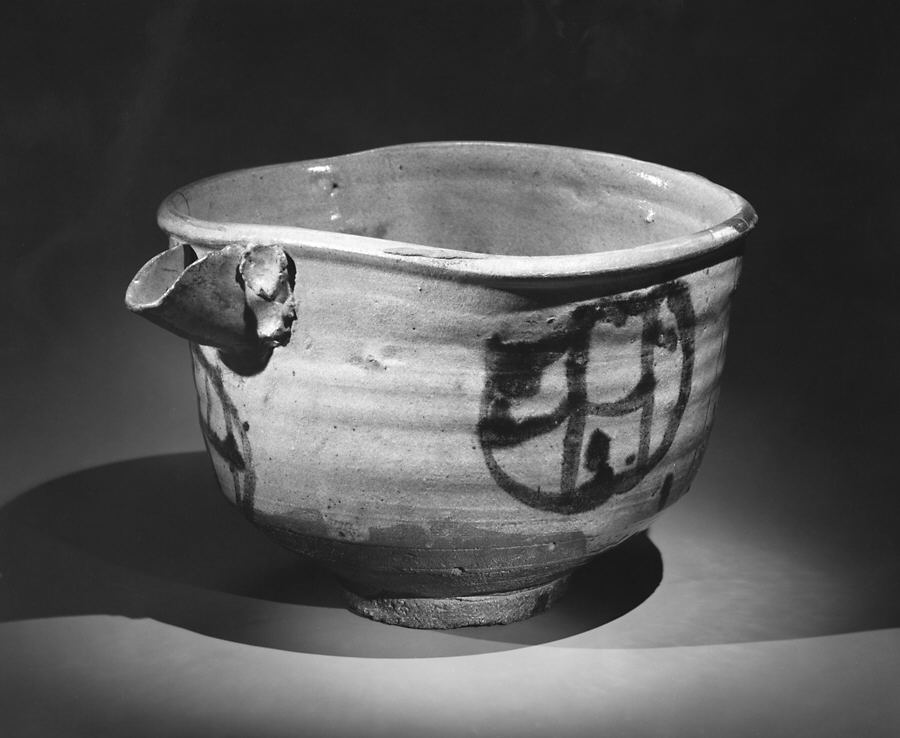
The Japanese pouring vessel in the Metropolitan Museum of Art has a broad opening that projects into a small spout at one point. On this early-seventeenth-century Karatsu ceramic, dark brush marks around the body appear alongside that projection. One draws attention to the painted surface, the other to the way the vessel is tilted.
Catalogued as Pouring vessel under 1975.268.448, this object shares a movement with the narrow-necked bottle used to bring pepper sauce to the table: tilting a container and giving its contents an exit direction. Its broad opening and small channel offer a visible form for following where flow is intended to leave the body.
Beginning with a small projection changes the habit of viewing a bottle only as a silhouette at a distance. The opening through which hot sauce passes lets us examine design where the movement of the hand meets the movement of the ingredient.
Sources For This Section
Why Might A Liquid Follow An Edge?
Liquid following the underside of a pouring edge is studied as the teapot effect. A 2010 Physical Review Letters paper by Duez and colleagues, following their 2009 preprint, examines controlled fast flows. In experiments with water and a water–glycerol mixture, edge curvature and wettability influence the direction in which the liquid separates.
Wettability describes a liquid’s contact behaviour with a surface. The study characterises this behaviour through the contact angle, measured on the liquid side where the solid surface and liquid surface meet. In Duez and colleagues’ explanation, a curved liquid surface called a meniscus lies between the flow and the edge. Its contact angle with the surface and the edge’s curvature determine the size of the wetted region. The pressure drop as the flow bends around the edge acts over this region. The balance between the liquid’s tendency to continue moving and this adhesion effect explains the separation direction in the experiment. Liquid properties, edge shape and surface thus meet in one mechanism.
The experiment varied the edge’s radius of curvature from 0.03 to 2 millimetres. Dripping occurred more readily at thicker, rounded edges. When glycerol approximately doubled the water’s viscosity, the separation angles measured at the same speeds overlapped. This comparison highlights the roles of surface and edge geometry in the fast flows studied.
Sources For This Section
An Architecture Below The Millimetre
Scheichl, Bowles and Pasias’ analytical study of 2021 examined the separation of a thin, steady liquid film from an edge at different scales. An edge treated as sharp at the larger scale was analysed as a wedge with a rounded tip at a much smaller scale. The relationships between flow, surface tension and wetting were examined within this small geometry.
The authors identify calculations still to be completed and a need for systematic experiments. The small edge remains an active research problem. At the model’s scale, a lip that looks like a line at the table becomes a surface whose curvature and contact with liquid require investigation. A small design detail can be the geometry at the centre of the flow problem.
Sources For This Section
How Hot Sauce Changes The Question
Placing a hot sauce with visible pepper particles beside these water experiments opens a new material question. The water–glycerol comparison tests two viscosities in the fast flow studied; it does not describe every pour of a particulate sauce. Assessing a bottle mouth with those contents requires observing the flow, particle structure and contact with the opening.
Terms such as particle, droplet and continuous phase help name what is moving. The label lists ingredients; tilting the bottle reveals how the mixture moves as a whole. The pepper and consistency of a hot sauce meet the outlet’s geometry in that moment of use. The article on sauce structure develops the material question further.
Designing The End Of A Gesture
The channel on the Karatsu vessel is small enough to guide flow and distinct enough to catch the eye. The laboratory model takes that attention down another scale, towards the edge’s curvature. We move from the large form that identifies a vessel to the small surface from which liquid separates.
At another pour, watch the movement remaining at the mouth as the bottle returns upright, as well as the sauce reaching the plate. Design can still be at work where the hand considers its part finished.
- Sauce structure: particles and flow
- The design language of a bottle
- Read the history of the sauce bottle
Sources For This Section
Sources And Further Reading
- The Metropolitan Museum of Art · Pouring vessel, Japan, early 17th century; 1975.268.448
Reading area: Object date, Japan and Karatsu-ware record; the vessel’s opening and surface decoration.
Accessed:
- Duez et al. · Beating the teapot effect, 2009 preprint; PRL 2010 journal record
Reading area: 2009 preprint and 2010 journal record; edge curvature, wettability and capillary meniscus under controlled fast flow; Figure 2 compares 0.03–2 mm edge radii and water/water–glycerol viscosities of 1 and 2 mPa·s.
Accessed:
- Scheichl, Bowles and Pasias · Developed liquid film… and the teapot effect, Journal of Fluid Mechanics, 2021
Reading area: Multiscale analytical model for a thin steady liquid film; rounded wedge tip and wetting; outstanding small-scale solutions and need for systematic experiments.
Accessed: