Table And Design
A History Of The Sauce Bottle: Glass Bodies And Closure Design
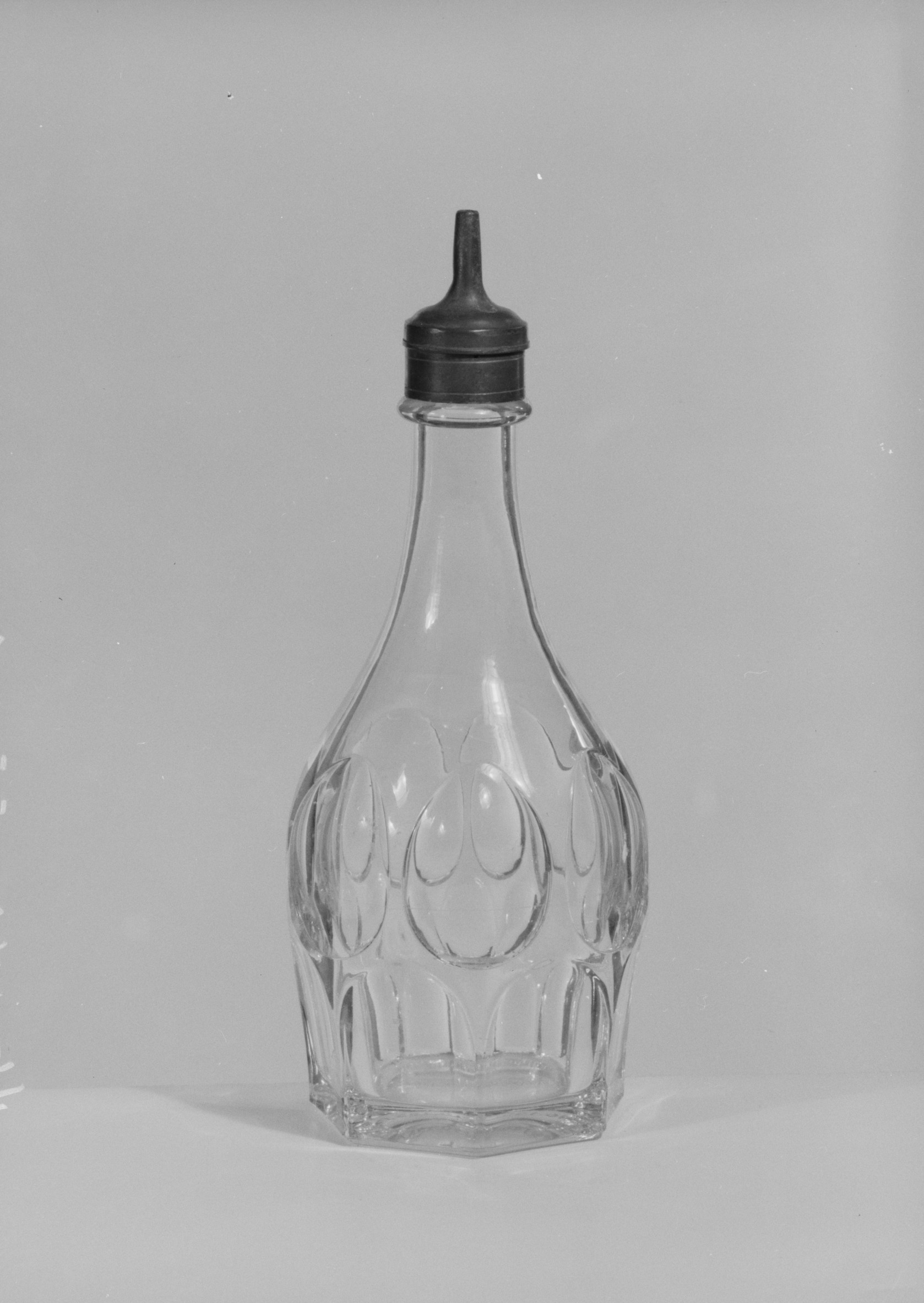
The patterned glass and separate stopper of a pepper sauce bottle dated 1860–70 in the Metropolitan Museum of Art recall a familiar sequence: open, tilt, close again. Behind those movements lie mechanisms for making the body, sealing its mouth and regulating the outlet. These three jobs offer a path through the bottle’s technical history.
Sauce Bottles Before Automatic Machinery
The pepper sauce bottle numbered 46.140.155a, b in the Metropolitan Museum of Art is American pressed glass dated 1860–1870. The museum identifies its surface pattern as ashburton. Patterned body, narrow opening and separate stopper belong together in this handheld object.
The pressed-glass pattern gives the sauce-bearing body a visible character. The bottle predates Owens’s 1904 patent, so the story begins with a table object before the automated glass-shaping machine. Neck, closure and outlet—the problems pursued in later patents—are already present here in one object to be held.
Sources For This Section
Screw Threads And Crown Caps: Different Solutions
On a screw-top bottle, the neck’s thread responds to the turning hand. John L. Mason’s US 22,186 patent of 30 November 1858 describes improvements to this part of bottles and jars. Mason refers to earlier work on screw closures; his concern here is the thread’s placement relative to the mouth and shoulder.
In the patent, the thread ends before reaching either the top or the bottom of the neck. A groove above the shoulder leaves room for the cap to descend and press the rubber washer into place. Where the thread ends matters to the closure as much as the thread itself.
William Painter’s US 468,226 patent of 2 February 1892 assigns the sealing job to different parts. The crown cap’s metal skirt locks onto a projection at the mouth, while a compressible inner disk presses against the rim to seal it. Retention and sealing are distributed across two components of a small closure. Metal that crimps into place takes the role played by the advancing thread of a screw cap.
Owens: Machinery That Repeats A Form
Michael J. Owens filed the application for his glass-shaping machine, US 766,768, on 13 April 1903; the patent was granted on 2 August 1904. Assigned to Toledo Glass Co., the apparatus combines gathering glass, forming a preliminary shape and blowing the final shape within one mechanism.
In the patented cycle, the lower end of the blank mould is dipped into molten glass; withdrawing the air draws glass into the mould. The mould is lifted and a blade cuts the strand of glass connecting it to the tank. Air then expands the blank into its final shape inside the blowing mould brought around it.
This cycle is a solution for repeating a bottle body by machine. The Corning Museum of Glass preserves a material example, Owens Bottle Machine 2004.7.1, dated 1912–1930. ASME’s 1983 landmark designation for the Owens AR Bottle Machine records its place in engineering heritage. Moving from the patent drawing to the museum machine expands our scale from a single glass body to the apparatus that makes it repeatedly.
Pouring Is Also A Design Problem
At the table, what passes through the mouth becomes decisive. US 74,869 of 1868 describes an improvement to a pepper caster-bottle. Frederick B. Thatcher’s US 574,013 patent of 29 December 1896 proposes a stopper for pepper sauce and similar condiments. Sprinkling dry spice and pouring a liquid condiment are uses that call for different arrangements at the outlet.
Thatcher’s stopper contains a small ball valve. When the bottle is inverted, the valve moves and liquid passes around it to the outlet ports; when the bottle is upright again, the valve closes the outlet. The patent relates the quantity passing through to the number and size of the ports. Making the parts easy to clean is another purpose of the design.
In Thatcher’s stopper, returning the bottle upright is itself the movement that closes the outlet. Flow-regulating holes and cleanable parts belong to the same small assembly. The glass carrying the pepper sauce and the opening delivering it become designed jobs at different scales: one unfolds in a production cycle, the other at the user’s wrist.
A Bottle Cap’s Second Life In A Museum
MoMA records William Painter’s Crown Bottle Cap design of 1892 as accession 165.2005. The museum also identifies it in installation photographs for Humble Masterpieces, held from 8 April to 27 September 2004. A small piece receiving only a glance in daily life can become the subject of a design study in a museum.
At the table, this history occupies only seconds. A hand grasps the body, removes the closure and tilts the bottle. The patterned museum bottle, the glass-forming machine and the closure patents show answers, from different dates, to different parts of that use. Holding a pepper sauce bottle today, we can begin to ask what work its body, neck and opening each perform.
Sources And Further Reading
- The Metropolitan Museum of Art · Pepper Sauce Bottle, 1860–70; 46.140.155a, b
Reading area: American pressed-glass pepper sauce bottle; ashburton pattern, 1860–70 date and accession record.
Accessed:
- USPTO · US 22,186, John L. Mason, 1858
Reading area: Threaded-neck improvements for bottles and jars, 30 November 1858; earlier work, thread endings, the shoulder groove and seating of the rubber washer.
Accessed:
- USPTO · US 468,226, Bottle-sealing device, William Painter, 1892
Reading area: The crown cap’s metal skirt retaining the closure and a compressible disk sealing against the rim, 2 February 1892.
Accessed:
- USPTO · US 766,768, Glass-shaping machine, Michael J. Owens, 1904 (Google Patents)
Reading area: Filed 13 April 1903; granted 2 August 1904; Toledo Glass Co.; suction gathering into the blank mould, cutting the glass connection and blowing to the final form.
Accessed:
- Corning Museum of Glass · Owens Bottle Machine
Reading area: Owens Bottle Machine, accession 2004.7.1, dated 1912–1930, Toledo.
Accessed:
- ASME · Landmark #86, Owens AR Bottle Machine, 1983
Reading area: Engineering landmark designation.
Accessed:
- USPTO · US 574,013, Bottle-stopper, Frederick B. Thatcher, 1896
Reading area: Stopper for 'pepper-sauce or like condiments'; automatic ball-valve closure, outlet ports and cleanable parts; 29 December 1896.
Accessed:
- USPTO · US 74,869, Improved pepper caster-bottle, 1868
Reading area: Pepper caster-bottle improvement.
Accessed:
- MoMA · Humble Masterpieces, 8 April–27 September 2004
Reading area: Exhibition record and installation views.
Accessed:
- MoMA · William Painter, Crown Bottle Cap, 1892; 165.2005
Reading area: William Painter, Crown Bottle Cap, 1892, accession 165.2005, and the object’s association with Humble Masterpieces.
Accessed: