Materials And Form
The Sound Inside A Bottle: The Shape Of Empty Space
As hot sauce is used, the bottle’s outer outline stays the same while the air space inside grows. Under suitable conditions, that hidden volume and the air in the neck can form a vibrating system. Investigating a bottle’s sound means asking what acoustic space lies inside the glass we hold at the table. An experiment with a tea bottle and a listening instrument from 1865 approach the answer from different directions.
Reading A Bottle From Within
The air-filled space opening to the outside through a bottle’s neck is called a cavity. Under suitable conditions, the air in the neck and this cavity can behave as a Helmholtz resonator. An audible response requires excitation; closing the cap also changes the conditions assumed for an open neck.
Body, shoulder and neck bound the space above the sauce. That inner space is small in a full bottle and grows as the contents diminish. We continue to recognise the same container while one variable of the acoustic model changes inside. The object followed by acoustics includes the air enclosed by the wall as well as the glass itself.
Sources For This Section
The Invisible Spring Of Air
UNSW explains this air through a mass–spring system. Air in and near the neck provides the moving mass; the compressibility of the body’s air provides the spring. Inward movement raises pressure, which pushes the air back; inertia carries it past equilibrium. Without an external energy supply, losses in the real system gradually damp that back-and-forth movement.
When the sound wavelength is much larger than the cavity, pressure throughout the cavity is assumed to vary approximately in phase: it rises and falls at nearly the same time at different points. This relationship between size and frequency supports treating the cavity’s air as a single spring.
Sources For This Section
How Geometry Sets The Pitch
In the ideal model, the size of the air space is only one influence on pitch. Sound speed, opening area and effective neck length also enter the frequency. Halving the air volume with other conditions fixed raises the frequency by about 1.41 times. Effective length includes more than a ruler measurement of the neck: nearby moving air at both ends also contributes.
This relationship can be written as:
Here c is the speed of sound in air, A is the opening’s cross-sectional area, V is the air volume in the cavity and Leff is the effective neck length. Volume appears in the denominator inside the square root, explaining why a larger air space gives a lower frequency when the other conditions remain unchanged.
The geometry seen at a sauce bottle’s neck acquires a more detailed counterpart in the model. Using up contents changes the air volume; imagining a different opening may change area and effective length too. The relation lets us specify which quantity a predicted change in sound is being linked to.
Monteiro and colleagues investigated the relation in 2018 using an approximately cylindrical tea bottle. Water was added at different levels, reducing the air volume, and the frequency produced by blowing across the mouth was tracked with a smartphone. Water level was the experimental variable. Considering the same relation for a sauce bottle likewise requires an open neck and suitable dimensional and frequency conditions.
The Tone Of Air And The Ring Of Glass
Striking a bottle can excite elastic motion in its glass wall. The participation of liquid in the moving system then becomes important. The model built from neck air and cavity air does not by itself describe every vibration of a sounding glass object.
In 2006, Jundt and colleagues used holographic methods to examine vibrations in partly filled glasses. Adding liquid lowered the glass resonance frequencies in their experiment. This result and the rising frequency of an ideal Helmholtz model with decreasing air volume describe two different mechanisms: one examines glass and liquid moving together, the other the response of an air cavity.
In the wine glass, liquid adds to the effective vibrating mass. With the same stiffness, increased mass lowers frequency. In an air cavity, shrinking air volume instead raises the ideal model’s frequency. Predicting the direction of a sound change as a vessel fills first requires identifying which vibration is being followed.
Sources For This Section
A Way Of Listening In An 1865 Catalogue
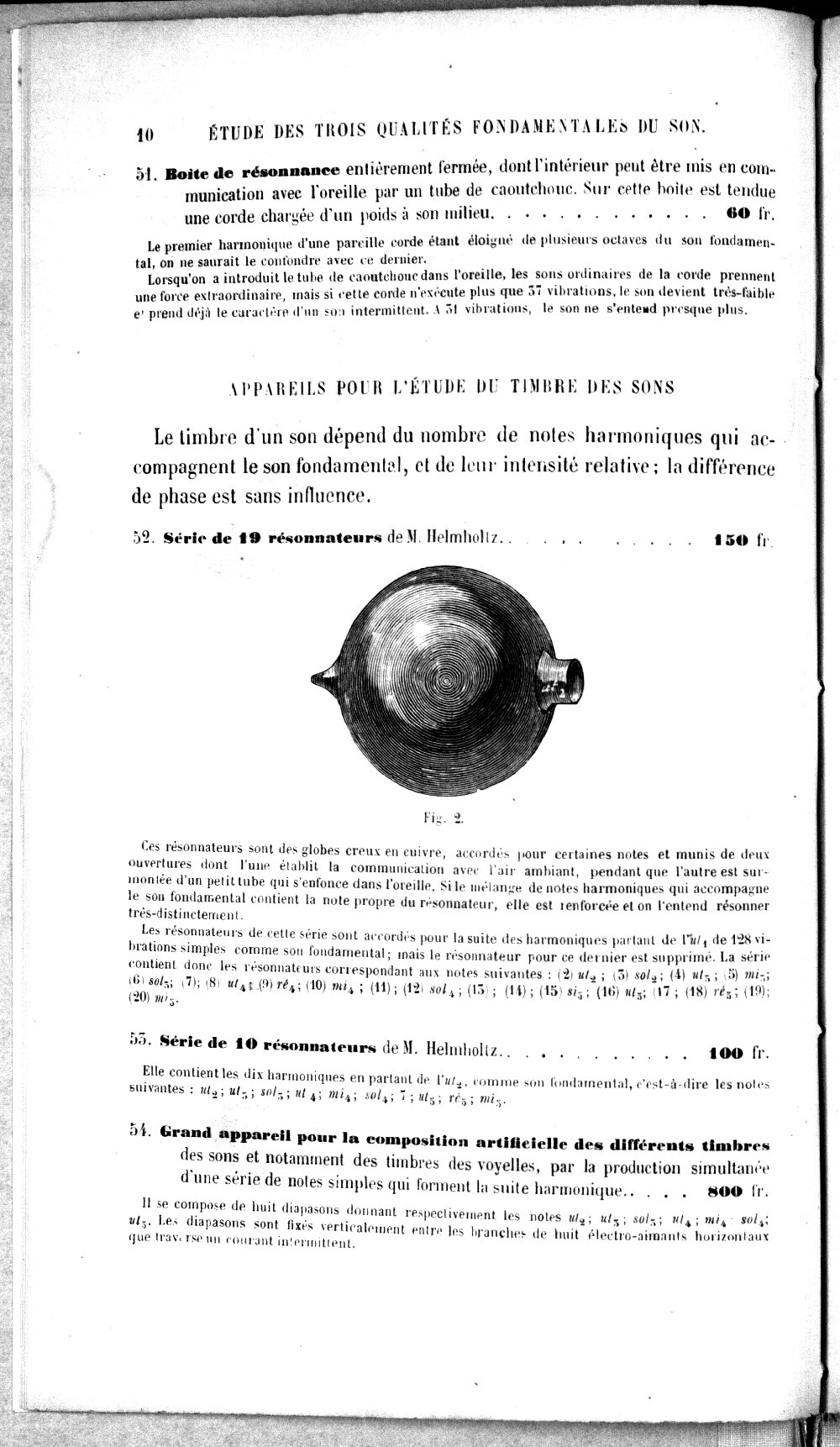
Returning to 1865 brings us to an example of the volume–opening relationship shaped specifically for listening. Page ten of Rudolph Koenig’s catalogue shows a spherical Helmholtz resonator and separately lists sets of nineteen and ten. This vessel houses an air volume intended to make a particular sound component more apparent.
The catalogue describes the sphere as a hollow copper body. One of its two openings communicates with the surrounding air; the other ends in a small tube placed in the ear. The openings therefore serve different purposes: one receives the surrounding sound while the other connects the resonator to the listener.
The catalogue describes hearing the component to which the resonator is tuned more clearly within a complex sound. As one opening reaches the surrounding air and another the ear, the space inside becomes a working part of an instrument. The volume left behind by contents in an everyday bottle is deliberately formed here for listening.
Sources For This Section
Accounting For The Cavity In A Laboratory
In 2010, Webster and Davies investigated the volumes of water, spheres and cubes using a purpose-built Helmholtz apparatus. Their system had nominal one-, two- and three-litre cavities, used microphone measurements and accounted for temperature. Calibration beyond the ideal relation was needed: water-filling experiments and regular solid samples were evaluated with different correction curves.
In this experiment, frequency leads to a volume estimate through the microphone and suitable calibration. Comparisons involving water, spheres and cubes make the relation between occupied space and remaining air measurable. The relation is also visible in a sauce bottle at the table; measuring quantity by sound requires a defined apparatus and appropriate calibration, as used in this study.
Sources For This Section
The Unseen Half Of A Familiar Form
Looking at a hot sauce’s colour can also reveal the volume above its fill line. The familiar shoulder, neck and opening become the boundaries of the air inside. As the sauce is used, what changes is the share of that bounded space occupied by air.
Acoustics adds a further question to the bottle’s appearance: what does the surface in our hand enclose? Behind label and glass is an interior space that, under suitable conditions, can contribute to a sound response.
Sources And Further Reading
- Joe Wolfe · Helmholtz resonance, UNSW Music Acoustics
Reading area: Neck-air inertia and cavity-air compressibility; long-wavelength assumption, ideal frequency relation and end corrections.
Accessed:
- Webster and Davies · The Use of Helmholtz Resonance for Measuring the Volume of Liquids and Solids, Sensors 2010
Reading area: Ideal relation, effective neck length, purpose-built 1–3 litre cavities, water/sphere/cube samples, microphone measurements, temperature compensation and volume inference through sample-dependent calibration.
Accessed:
- Jundt and colleagues · Vibrational modes of partly filled wine glasses, JASA 2006
Reading area: Glass–liquid vibration experiment and holographic measurements; decreasing glass resonances as liquid is added, a different mechanism from an air cavity’s Helmholtz frequency.
Accessed:
- Rudolph Koenig · Catalogue des appareils d’acoustique, Paris 1865, p. 10 · Smithsonian Libraries
Reading area: Page ten, figure 2 of the 1865 catalogue: hollow copper spherical resonator, two openings connecting to ambient air and the ear, and separately listed sets of nineteen and ten resonators.
Accessed:
- Monteiro and colleagues · A bottle of tea as a universal Helmholtz resonator, original study 2018
Reading area: Four-page original preprint: open-neck air cavity, geometric relation, effective length and long-wavelength condition; changing water levels in a tea bottle and frequency measurement with a smartphone.
Accessed: