History And Thought
Escoffier And The Language Of Sauces: Bases, Derivatives And Names
Hungarian Sauce, number 85 in Escoffier’s English book, brings paprika into a velouté-based preparation. It is a small example of what a sauce name can hold: a foundation, an added ingredient and work to be done. Moving between the French Le Guide culinaire of 1903 and the revised English edition reveals a network wider than a single list of five.
A Base Sauce: A Starting Point For Other Preparations
Understanding Hungarian Sauce first requires knowing velouté. A mother or base sauce provides a starting point in just this way. The English book’s separate chapters for leading warm sauces and smaller compound sauces help a cook follow that route back.
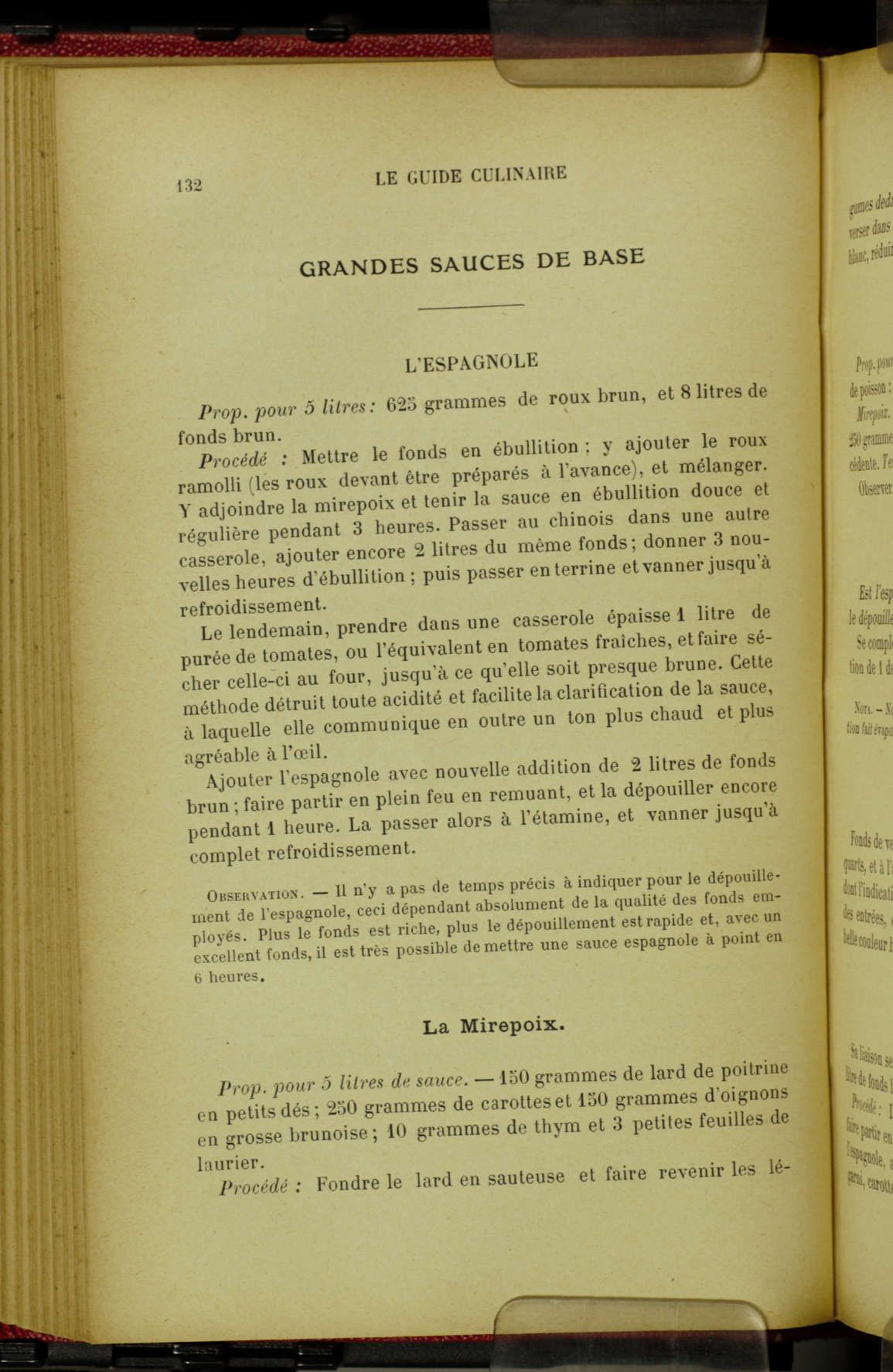
In the Grandes sauces de base section of the 1903 French edition, espagnole, velouté, béchamel and tomate appear alongside demi-glace, jus de veau lié, allemande and suprême. Short explanations, subheadings and cross-references introduce them. The section teaches a network of relationships wider than the memorisation of five names.
Foundations Of Milk, Stock And Tomato
Stock here means a foundational liquid preparation such as meat, chicken or fish stock. One concrete difference between béchamel and velouté is this liquid foundation: the 1903 text associates béchamel with milk and velouté with white stock. Espagnole belongs among preparations using brown stock; tomate combines tomato with other ingredients. The liquid shows where the historical formula begins.
Roux is the thickening preparation made by cooking flour with fat. In the 1903 formulas, white roux is combined with milk for béchamel, while blond roux is combined with white stock for velouté. Alongside the milk or stock, we can therefore identify the preparation used to thicken the liquid.
Knowing that a paprika preparation starts from velouté changes our view of the pepper’s role. Pepper joins an existing foundation rather than accounting for the entire structure. Following the ingredient back to that base reveals relationships among stock or milk, fat and thickener behind the short name.
Different Places For Hollandaise And Mayonnaise
In the 1903 edition, hollandaise appears among small white and compound sauces; mayonnaise is described as sauce froide mère, a cold mother sauce, in the cold-sauce section. The relevant pages are 150 and 163. A sauce’s role as a foundation and the heading under which a book places it are two distinct details worth following together.
The English A Guide to Modern Cookery used for comparison is the 1920 printing of the new and revised 1909 edition. Hollandaise is preparation 30 in The Leading Warm Sauces. Distinguishing this printing from the French text of 1903 makes the sauce’s different position in the two arrangements visible.
| Record | Arrangement Observed |
|---|---|
| Le Guide culinaire, 1903; Grandes sauces de base | Several basic preparations with explanatory relationships |
| The same copy, hollandaise; p. 150 | Series of small white and compound sauces |
| The same copy, mayonnaise; p. 163 | Described as a cold mother sauce |
| Revised English edition, 1920 printing; no. 30 | Hollandaise in The Leading Warm Sauces |
Mornay And Mousseline: An Earlier Preparation Within A New Name
The English book’s Mornay formula begins with béchamel; a flavourful liquid preparation, or fumet, from fish, poultry or vegetables is added before the sauce is reduced. Gruyère and Parmesan are stirred in and melted, then the sauce is taken off the heat and finished with butter. Mousseline refers back to hollandaise and is completed with whipped cream just before serving. In these two preparations, numbered 91 and 92, a new sauce is explained through one already defined.
In Hungarian Sauce, paprika enters with onion and white wine before velouté is added; the sauce is strained and finished with butter. Escoffier asks that its pale pink colour come from paprika alone. Pepper has a role in appearance as well as in the preparation. Like the cheeses in Mornay and cream in mousseline, it helps give the derivative its direction.
Sources For This Section
Reading Sauce Names Alongside Their Verbs
Reduction, straining, binding and finishing are important parts of understanding Escoffier’s preparations. A sauce name can refer to an ingredient, an earlier preparation or a final operation. A single word on a restaurant menu can point to a longer sequence described in a professional text.
Seeing paprika in Hungarian Sauce identifies an ingredient; reducing, straining and finishing tell us what happens around it. We need more than ingredient names to describe a pepper sauce today too. Asking where an ingredient takes its place within a preparation is a reading habit we can carry from Escoffier’s vocabulary into present-day cooking.
A Short Name For Culinary Knowledge
The sauce name is short; the relationship explaining it is longer. A cook who knows velouté does not begin again from nothing when turning to Hungarian Sauce. An earlier preparation makes room for a new ingredient and sequence. The book’s cross-references turn this shared knowledge into a written kitchen language.
Paprika is no longer just a spice at the edge of a list: it becomes a decision changing a base sauce’s colour and character. Following that decision is more revealing than memorising a few names. Behind the short name lies a preparation that can be made again.
- Follow editions and individual copies of culinary texts
- Read the ingredient and texture vocabulary of sauce character
Sources For This Section
Sources And Further Reading
- Escoffier · Le Guide culinaire, 1903 copy
Reading area: OCR of the BnF copy; Chapter III, Sauces, in the 1903 French edition: base preparations and roux on pp. 132–135, hollandaise on p. 150 and mayonnaise on p. 163.
Accessed:
- Escoffier · A Guide to Modern Cookery, 1920 printing
Reading area: Escoffier’s A Guide to Modern Cookery: sauce classification and derivatives; onion, paprika, white wine, velouté and butter in Hungarian Sauce no. 85.
Accessed: