History And Thought
From Recipe Notebooks To Table Memory
An old recipe bears the heading “Chilli Vinegar”; another fits, in Rosa Parks’s handwriting, on the back of a bank envelope. The distance between printed heading and handwritten note reveals how many routes culinary knowledge can take. A pepper’s name, a correction or the edge of a page may become an unexpected carrier of that memory.
Rosa Parks: A Recipe On The Back Of A Bank Envelope
An article published by the Library of Congress on 24 September 2026 describes Parks’s Featherlite Pancakes recipe, written on the back of a deposit envelope from Detroit’s First Independence National Bank. The handwritten document is preserved in the Rosa Parks Papers.
The writing surface is part of the story. An envelope made for a bank becomes, in Parks’s hands, a page carrying kitchen knowledge. Within the archive of a public life, handwriting also leaves a personal food practice visible.
Sources For This Section
An Identity Card For A Recipe Document
| Field | Detail Identified In The Record |
|---|---|
| Recipe name | Featherlite Pancakes |
| Person | Rosa Parks |
| Physical support | Back of a bank envelope |
| Collection | Rosa Parks Papers, Library of Congress |
After encountering a recipe, we may want to find it again. Title, handwriting, envelope and collection establish a route back to Parks’s page. What survives is more than an ingredient list: it is the form that list took in a particular hand and on a particular surface.
Sources For This Section
Food Culture Lives Around The Recipe Too
The tenth edition of Eliza Leslie’s Directions for Cookery, dated 1840, includes a short preparation called “Chilli Vinegar”. It describes pieces of fresh red chillies or capsicums infused in vinegar and then strained. This brief entry makes both the pepper’s name and its kitchen role visible under a single heading.
The Library of Congress Foodways guide considers recipes passed through families and communities alongside growing, preparing, eating together and storytelling. These relationships, from cultivating an ingredient to discussing it at the table, are documented parts of food culture.
Parks’s handwriting and Leslie’s printed heading retain choices made in transmitting a recipe. One uses the envelope at hand; the other names pepper in the heading “Chilli Vinegar”. Local words, a teller’s voice and notes added later can likewise become part of what a family recipe carries forward.
From Personal Record To Archive
The Library of Congress index of manuscript cookbooks and recipes provides access to culinary records within personal and family papers. A recipe’s folder may belong to a wider set of documents about someone’s life. Archival organisation opens the records around an individual page to investigation.
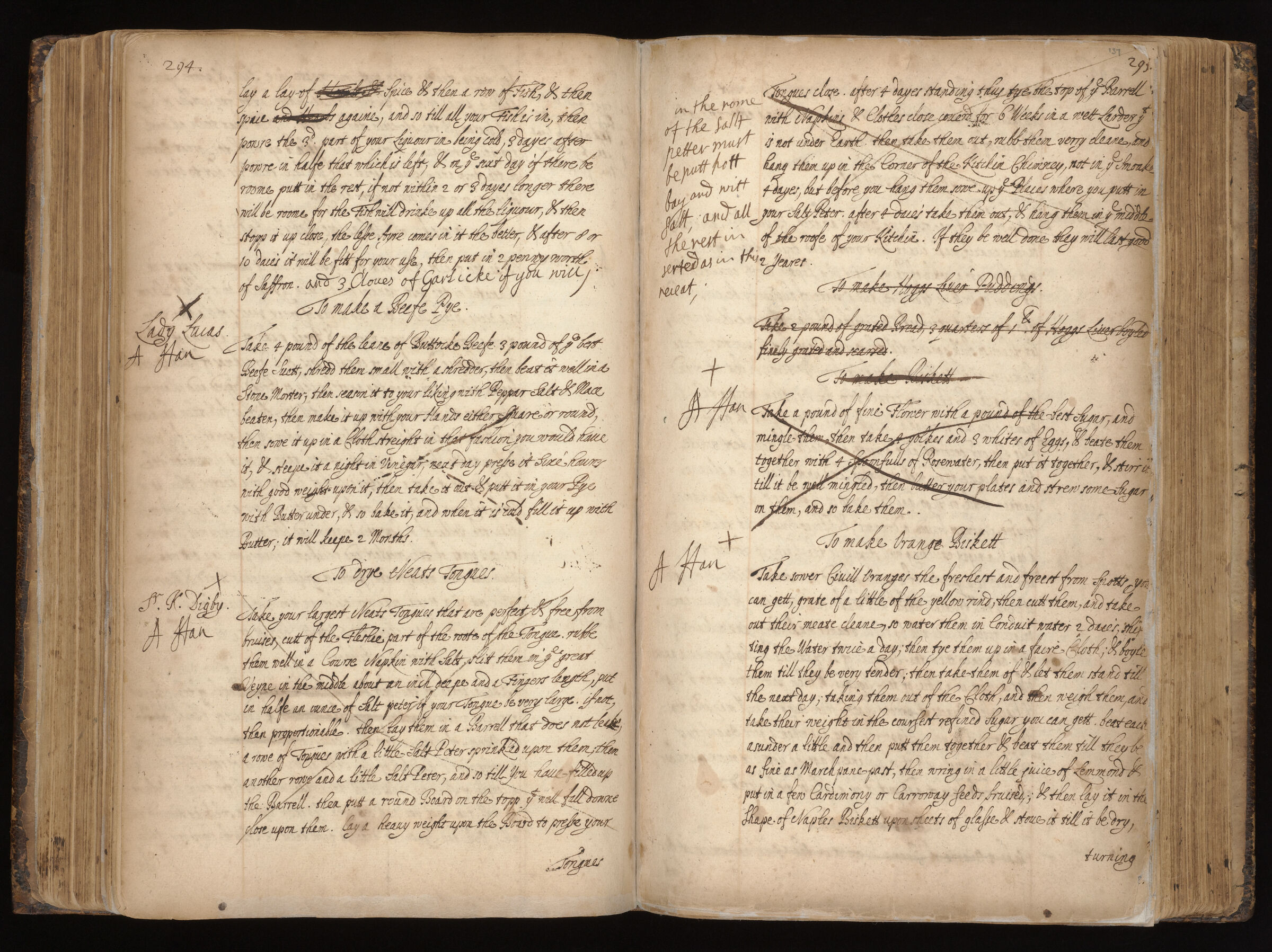
Ann Fanshawe’s book shows how different hands can come together under one name. The Wellcome catalogue identifies the earliest entries as Joseph Averie’s handwriting and notes that many were signed by Ann Fanshawe; it also records later hands. Ownership of a book, the person who supplied a recipe and the person who wrote it down can thus be investigated separately.
Mehmed Kâmil’s Melceü’t-Tabbâhîn is studied as the first printed Turkish cookbook. The İBB Atatürk Library catalogues its 1260/1844 printing, and the Turkish Grand National Assembly Library’s open-access system records a copy dated 1844. The 132-page İBB edition has accession number Bel_Osm_O.01476. The title links these records, while each library’s particular copy retains its own identity.
American Cookery: Work, Edition And Copy
A printed recipe does not have a single unchanging surface either. Editions change, errata leaves are inserted and pages can be lost. The Leslie text consulted here identifies itself as the tenth edition of 1840, while its preface is dated 15 April 1837. Naming the edition beside a recipe preserves these small differences in time.
The Library of Congress describes Amelia Simmons’s American Cookery as printed in Hartford by Hudson & Goodwin in 1796. The notes for LCCN 96126967 record an errata leaf and damage specific to this copy. The errata leaf is bound after page 24; the upper-right corner of the title page and the lower half of the final leaf are missing. The same record thus describes both the publication and the condition of the surviving copy.
The 1796 date belongs to the printing of Simmons’s book. A later digital image does not give the recipe a new date of composition. Like Parks’s envelope and Leslie’s differently dated preface, the copy carries traces of more than one moment.
An errata leaf therefore cannot be dismissed as a small addition around the book’s edges. It may change a recipe’s quantities. Identifying it alongside author, short title, edition and page lets another reader return to the same version of the preparation.
For the second rice pudding on page 25 in American Cookery, the errata leaf instructs the reader to use half a pound of butter in place of one pound, and eight eggs in place of fourteen. The correction changes the recipe’s ingredient quantities. Reading the book’s main pages alone and reading them with the inserted leaf therefore produce a concrete difference.
How Is “Sugar” Read?
Ashley Rose Young’s 2026 article in the Library of Congress Bibliomania blog explains the long s in American Cookery. The first character in the historical printed form ‘ſugar’ is read as s: the word is sugar. Recognising the letterform prevents it from being mistaken for another letter today. The same article examines the errata leaf as part of the book’s transmission.
The Folger Shakespeare Library’s discussion of transcription compares different purposes in carrying texts into the present. A modernised transcription may favour reading ease; a diplomatic transcription may preserve original textual and material features in greater detail. Stating the approach gives readers information about the letters and spellings they see. Explaining the reading purpose alongside the editorial choice makes the relationship between original page and present-day text traceable.
The semi-diplomatic practice described for Folger’s The Collation blog makes this choice concrete: original spelling, punctuation and capitalisation are preserved, as are u/v and i/j, while the long s is rendered as a modern s. A transcription can keep its connection to the original page while treating letterforms differently, provided it explains those choices.
Leaving A Record For Today’s Recipe
Imagine opening a pepper-sauce notebook today. On the first page we enter the pepper’s name, the date and the quantities; beside a later attempt we note what changed. A note that leaves the earlier line intact preserves the route between preparations. Leslie’s heading, Parks’s envelope and Simmons’s errata do not teach us one way to write. They make us attentive to how a particular version survives.
Sources And Further Reading
- Library of Congress · Rosa Parks’s handwritten recipe, 2026
Reading area: Featherlite Pancakes record: handwriting, bank envelope and holding collection.
Accessed:
- Library of Congress · Foodways archives
Reading area: Cultural relationships among recipes, growing, shared meals and storytelling.
Accessed:
- Library of Congress · Manuscript recipe collections
Reading area: Research index of manuscript recipes in personal and family archives.
Accessed:
- Acar Tek and Sürücüoğlu · The first printed Turkish cookbook, Melceü't-Tabbâhîn, 2014
Reading area: Book identity and 1260/1844 edition; [full text](https://dergipark.org.tr/en/download/article-file/76857), pp. 226–228: twelve sections and recipes in the page margins.
Accessed:
- İBB Atatürk Library · Catalogue record, Melceü't-Tabbâhîn
Reading area: The 1260 printing in the catalogue.
Accessed:
- Turkish Grand National Assembly Library Open Access · Melce'üt-tabbahin, 1844
Reading area: Record of a copy dated 1844.
Accessed:
- American cookery — Amelia Simmons; LCCN 96126967
Reading area: Hartford, Hudson & Goodwin, 1796; copy notes for LCCN 96126967: errata after p. 24, upper-right title-page corner and lower half of final leaf missing. [Catalogue view](https://www.loc.gov/item/96126967/?loclr=iloc).
Accessed:
- ſugar and ſpice and everything…not so nice?
Reading area: Ashley Rose Young, 18 February 2026: long s and the errata leaf; correction to half a pound of butter/eight eggs in Rice Pudding No.2. [Errata leaf](https://blogs.loc.gov/bibliomania/files/2026/01/American-cookery_errata.png).
Accessed:
- u/v, i/j, and transcribing other early modern textual oddities
Reading area: Comparison of transcription aims; the transcriptions section describes The Collation blog’s semi-diplomatic practice: original spelling, punctuation, capitalisation, u/v and i/j retained, long s rendered as modern s.
Accessed:
- Wellcome Collection · Ann Fanshawe recipe book, MS.7113
Reading area: Compiled 1651–1707; Description identifies Joseph Averie’s handwriting, Ann Fanshawe’s signatures, later hands and recipe attributions.
Accessed:
- Eliza Leslie · Directions for Cookery, tenth edition, 1840
Reading area: Tenth edition of 1840; preface dated 15 April 1837 and Chilli Vinegar in Flavoured Vinegars. Naming peppers and preparing them with vinegar in a historical recipe.
Accessed: