Peppers And Botany
A Geographic Atlas Of Peppers: Place, Names And Kitchens
Peppers dried and sweated in Şanlıurfa, fruit threaded into strings in Espelette, seeds selected across generations in northern New Mexico: a place name can carry different parts of a pepper’s life. At each stop in this atlas, we ask what connects the name to a process, a product or the people sustaining it.
Şanlıurfa: Recognising The Name And The Process
Şanlıurfa Biberi is registered with TÜRKPATENT as designation of origin number 33. Its geographical area is the province of Şanlıurfa. The older registration document calls the product ‘Biber (isot)’, bringing a familiar kitchen word and the official product name together in the same record.
Two dates accompany this record: 29 April 2001 on the document’s first page as its publication date, and 26 February 2002 in the current portal’s registration field. Both belong to the product’s official history; the earlier document’s publication should not be reported as the registration date.
In the document’s household method, sun-drying is followed by sweating in bags and another drying stage. A place shown by one name on the map begins to appear through the ingredient’s changing forms. Recognising isot includes recognising this work between red fruit and processed pepper.
Maraş And Isot: The Scope Of A Name
Maraş Biberi is designation of origin number 43; its registration document was amended in 2020. The defined area spans six provinces: Kahramanmaraş, Hatay, Gaziantep, Adıyaman, Kilis and Şanlıurfa.
The document identifies three processed forms: hot red powder, hot red flakes and hot black flakes. For the black flakes, it describes broken peppers undergoing fermentation through ‘kızıştırma’ techniques and the red colour turning naturally black; it says this form is popularly called isot. ‘Fermentation’ is the term used in the document’s production account; microbial species and biochemical transformations are subjects for separate scientific investigation.
The drying and sweating described in Şanlıurfa’s document published in 2001 can be approached from another angle through research from 2016. Korkmaz, Aydoğdu, Mutlu and Atasoy describe four stages in traditional isot preparation: preliminary drying, sweating, final drying and grinding. They compared two processing methods using peppers of the Urfa-type Capsicum annuum cultivar İnan3363. The traditional method produced higher total carotenoid content and some higher colour measurements, while moisture, pH, titratable acidity and hue angle were similar between methods.
Around the word isot we therefore find both Şanlıurfa’s designation-of-origin record and the black-flake description in the Maraş specification. Hearing the same word does not guarantee the same product. The processing description helps identify the form we are seeking in the kitchen.
Designation Of Origin And Geographical Indication
TÜRKPATENT’s explanation of Article 34 of Industrial Property Law No. 6769 describes a designation of origin as covering products whose qualities are wholly or essentially due to a geographical area’s natural and human factors. Production, processing and all other operations take place within that area.
For a mahreç işareti, a particular quality, reputation or other characteristic is associated with the geography; at least one of production, processing or other operations takes place in the defined area. Registration therefore specifies how the product relates to its place as well as naming that place.
Antep / Gaziantep Biber Salçası and Hatay Biber Salçası are registered as mahreç işareti. Çermik Biberi and Cemele Biberi are designations of origin.
Each product specification defines its own raw-material and processing requirements alongside this general classification. The geographical-indication specification for Hatay Biber Salçası requires the kapya peppers used to be grown within the defined area. Reading the type of indication together with the detailed production specification gives a fuller account of the product’s geographical link.
Registered Examples From Türkiye
| Product | No. | Type | Area | Document Or Date Information |
|---|---|---|---|---|
| Şanlıurfa Biberi | 33 | Designation of origin | Şanlıurfa | Document published in 2001; current register: 26 February 2002 |
| Maraş Biberi | 43 | Designation of origin | Kahramanmaraş, Hatay, Gaziantep, Adıyaman, Kilis, Şanlıurfa | 2020 amendment |
| Çermik Biberi | 717 | Designation of origin | Çermik, Diyarbakır | 2021 |
| Cemele Biberi | 956 | Designation of origin | Çayağzı village, central Kırşehir | 2021 |
| Antep / Gaziantep Biber Salçası | 1222 | Mahreç işareti | Gaziantep | 2022 |
| Hatay Biber Salçası | 1656 | Mahreç işareti | Hatay | 2024 |
The name Cemele in the table offers a small example of geography preserved in memory. According to the registration document, Cemele is the former name of Çayağzı village. The same document states that seed saved from the plants is used in the next growing season. Continuity of the place name and of the seed appears together in this record.
Espelette: One Place, Three Product Forms
France’s Ministry of Agriculture associates Piment d’Espelette’s production area in the Basque region with ten municipalities. The pepper is presented in three forms: fresh whole fruit, strings of peppers and powder.
Fresh fruit, strings and powder carry the same production geography in different forms. The whole pepper’s outline repeats along a string; grinding removes that outline. The ministry’s boundary description is equally specific: only part of the municipality of Espelette lies within the area. The place name asks for precision on the map as well as in the product’s form.
Sources For This Section
Northern New Mexico: Communities In Variety Names
New Mexico State University connects northern New Mexico’s pepper landraces with selection carried out by farming families across generations. Chimayo and Alcalde are examples named for their communities of origin. The guide’s “New Mexico Landrace Chile” section also describes these landraces as well adapted to the area’s cooler growing conditions and shorter season.
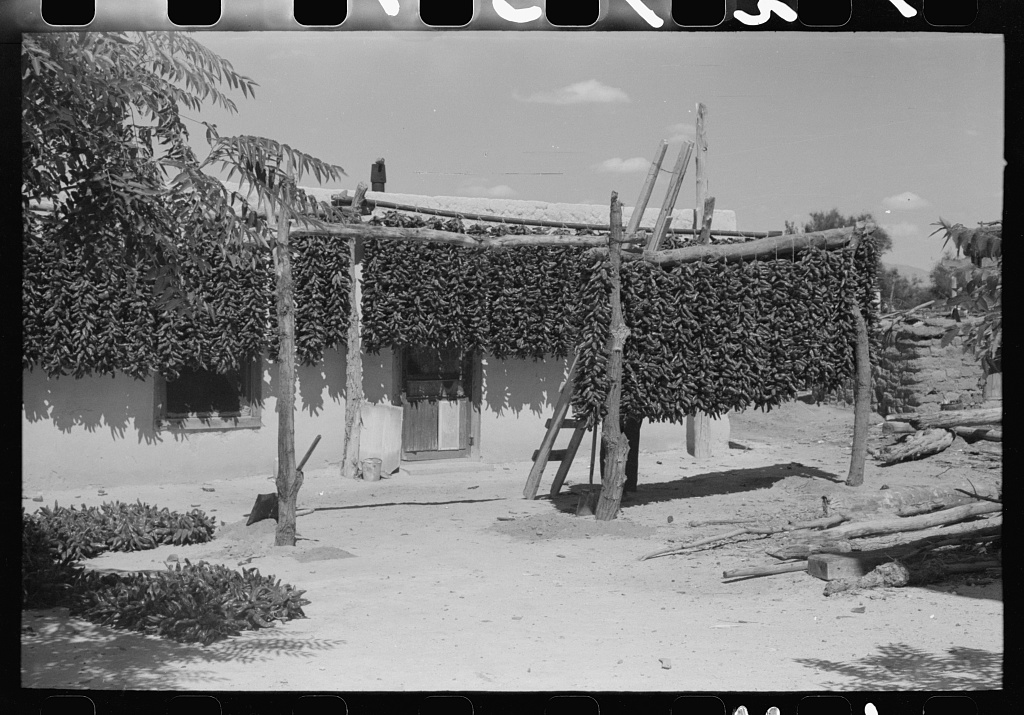
Chimayo and Alcalde locate communities while also recalling selection maintained within them. Decisions by farming families carry seed into another season. Geography appears here as generations of work deciding which pepper to grow again under particular conditions.
Sources For This Section
Reading Three Stops Together
| Place | Source | Concrete Information |
|---|---|---|
| Şanlıurfa | TÜRKPATENT, designation of origin No. 33 | Product name “Biber (isot)”; document published in 2001 |
| Basque region | French Ministry of Agriculture, Piment d’Espelette | Ten municipalities; fresh, strung and powdered forms |
| Northern New Mexico | NMSU, H-230 | Chimayo and Alcalde; generations of family selection |
Processing in Şanlıurfa, product forms in Espelette and seed selection in New Mexico give the atlas three different movements. A place name on a sauce or spice can prompt us to look for the connection behind it: specified production, a particular presentation or a variety sustained over time.
Pepper Does Not Always Denote The Same Plant
Before locating a place on the map, we need to know which plant the name denotes. A seemingly small translation choice can lead towards an entirely different geography.
The English word pepper makes this distinction visible. Kew records black pepper as Piper nigrum in the Piperaceae family. Capsicum peppers belong to Solanaceae. One everyday word can refer to these different plants.
When translating a historical text, its plant description, ingredient form or accompanying image can help establish which meaning is intended. If the text says only pepper, adding a particular species name introduces a further claim into the translation.
Sources For This Section
Chile And Chili: Preserving Local Usage
NMSU’s Chile Pepper Institute explains that in its own usage chile denotes the plant or fruit and chili a prepared dish. In the institute’s language, spelling helps distinguish an ingredient from a meal.
Keeping chile in the institute’s name respects its local vocabulary. Another English text may follow another usage. Imposing one spelling everywhere would narrow the linguistic variety the atlas is meant to reveal.
Sources For This Section
Species Name, Native Range And The Ingredient In A Bottle
Kew’s Plants of the World Online accepts Capsicum chinense as a species name and describes its native range from southern Guyana to southwestern Suriname and northern Brazil. A species name can be considered alongside this distribution rather than translated as a country of origin.
A species’ native range does not by itself locate the peppers in a particular sauce bottle. That requires geographical information tied to the product.
At the end of the atlas, a place name on a label deserves a slower reading. We have followed processing in Şanlıurfa, boundaries and forms in Espelette, and selected, saved seed in Chimayo. With those particulars intact, pepper geography says more than a country name.
- Follow genus and species names in the botanical portrait
- The Chili Pepper’s Journey: From American Traces To European Pages
Sources For This Section
Sources And Further Reading
- TÜRKPATENT · Şanlıurfa Biberi registration
Reading area: Şanlıurfa Biberi, designation of origin No. 33; registration date of 26 February 2002 in the current register.
Accessed:
- TÜRKPATENT · Maraş Biberi registration document (No. 43; 2020 amendment)
Reading area: Designation of origin; six provinces; powder, flakes and black flakes (isot).
Accessed:
- TÜRKPATENT · Şanlıurfa Biberi, geographical-indication document no. 33
Reading area: Designation of origin, Biber (isot), Şanlıurfa province and its production framework. The publication date of 29 April 2001 on the scanned document and registration date of 26 February 2002 in the current register are separate fields.
Accessed:
- Korkmaz, Aydoğdu and colleagues · Isot spice produced by traditional and factory methods, Harran Journal of Agricultural and Food Science 2016
Reading area: Comparison of two processing methods using Urfa-type C. annuum İnan3363 peppers: four stages, carotenoid and specific colour results, and similar moisture, pH, titratable acidity and hue angle. [Full text, pp. 205–211](https://dergipark.org.tr/tr/download/article-file/225588).
Accessed:
- Industrial Property Law No. 6769, Article 34
Reading area: Definitions of designation of origin and mahreç işareti.
Accessed:
- TÜRKPATENT · Antep / Gaziantep Pepper Paste registration document (No. 1222)
Reading area: Mahreç işareti, 2022.
Accessed:
- TÜRKPATENT · Hatay Pepper Paste registration document (No. 1656)
Reading area: Geographical indication, 2024; the Product Description and Distinctive Characteristics section requires kapya peppers grown within Hatay’s defined area.
Accessed:
- TÜRKPATENT · Çermik Biberi registration document (No. 717)
Reading area: Designation of origin, 2021.
Accessed:
- TÜRKPATENT · Cemele Biberi registration document (No. 956)
Reading area: Designation of origin, 2021; Cemele is the former name of Çayağzı village; seed saved from production plants is used the following season.
Accessed:
- TÜRKPATENT · Geographical indications, designations of origin and mahreç işareti
Reading area: The authority’s explanation of Law 6769, Article 34: geographical qualities and processing location are considered together.
Accessed:
- French Ministry of Agriculture · Piment d’Espelette
Reading area: The production area defined across ten municipalities, including only part of the municipality of Espelette; three product forms and use in chocolate.
Accessed:
- NMSU · Growing Chiles in New Mexico, H-230
Reading area: H-230, “New Mexico Landrace Chile” section: community-named landraces including Chimayo and Alcalde; generations of farming-family selection and adaptation to the area’s cooler growing conditions and shorter season. HTML version, revised August 2025.
Accessed:
- Piper nigrum L. — Plants of the World Online
Reading area: The distinction between Piper/Piperaceae and Capsicum/Solanaceae.
Accessed:
- FAQ’s — Why do I see chile spelled so many different ways?
Reading area: The institute’s own chile/chili usage, distinguishing plant or fruit from a prepared dish.
Accessed:
- Capsicum chinense Jacq. — Plants of the World Online
Reading area: The accepted species name Capsicum chinense and its native range.
Accessed:
- TÜRKPATENT · Geographical Indications and Traditional Product Names Application Guide, 2026
Reading area: Concepts, p. 1: the geographical link and location of operations required by menşe adı and mahreç işareti.
Accessed: