Peppers And Botany
The Language Of Chilli Peppers: Structure And Scoville
Behind an SHU value lie a pepper’s tissues, harvest, sample preparation and calculation method. An update in 2026 even changed calculated values for the same samples. Moving from a pepper’s cross-section to the details of that calculation gives the question ‘How hot is it?’ more meaning.
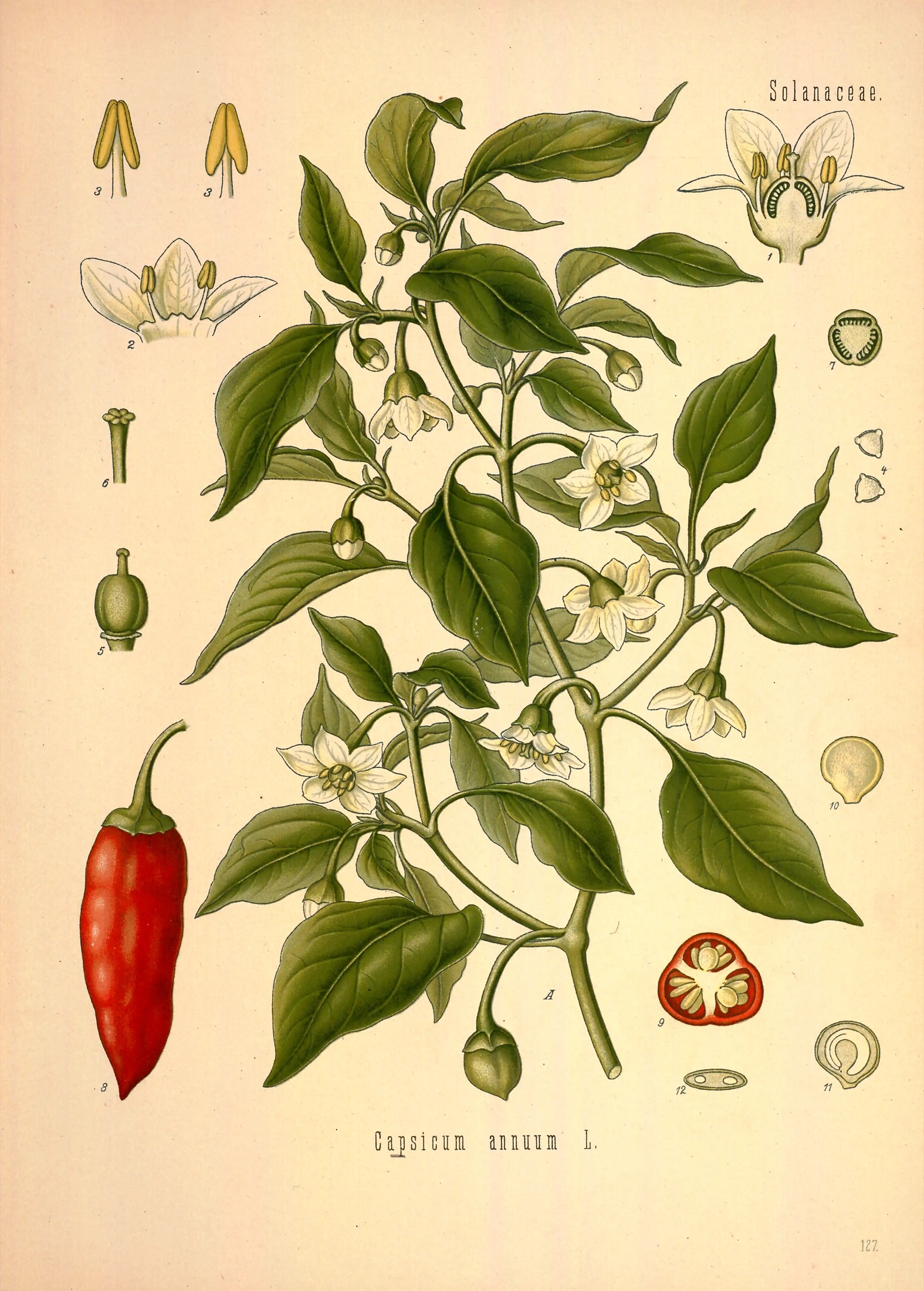
The Inner Architecture Of A Fruit
Cut a pepper open and its silhouette gives way to another arrangement: the fruit wall encloses a space, and seeds attach to internal tissues. Distinguishing these structures is the first step towards asking where pungency develops. The cross-section opens a route into the question of how hot a pepper is.
NMSU’s cultivar publication describes the role of the inner tissue called the placenta in capsaicinoid production. Seeds attach to it; their surfaces can encounter capsaicinoids through proximity and contact. The seed, the tissue carrying it and the compounds associated with heat can therefore be considered separately.
Sources For This Section
From Scoville To Analytical Measurement
SHU abbreviates Scoville Heat Units. NMSU’s measurement guide explains approaches ranging from the historical sensory test to analytical capsaicinoid measurement. HPLC, high-performance liquid chromatography, examines which capsaicinoids occur and in what amounts.
In Wilbur L. Scoville’s 1912 note, an alcoholic pepper extract is diluted with sweetened water until a distinct but weak pungency remains. Human sensation forms part of this comparison. In analytical methods, HPLC measures capsaicinoids and specified factors are used to calculate SHU. Sample name, method and record date allow us to follow how a result was obtained.
The HPLC calculation also interprets the signal recorded by the instrument. ASTA Method 21.3 accounts separately for nordihydrocapsaicin, capsaicin and dihydrocapsaicin. Each compound’s detector response is compared with a standard, its heat factor is applied, and the three contributions are added. Converting a chromatographic signal into SHU therefore accounts for both the instrument’s response and the different weights assigned to the compounds.
Method version matters too. The April 2026 revision of ASTA Method 21.3 updated detector-response factors for capsaicin. In the association’s comparison, values calculated for the same samples were approximately 5–6% lower with the new method. The calculation factors changed; that does not establish a reduction in sensory heat. ASTA anticipates retiring the 2004 version in April 2031. An SHU record should therefore be read with its method version.
A Tissue Map Of Chilli Heat
Looking closely at the placenta, where the seeds attach, brings us to smaller structures associated with pungency. The NMSU publication describes glands and small sacs, or vesicles, associated with capsaicinoids. Their presence on a seed’s surface also draws attention to contact: where a compound is found and the tissue that produces it are distinct questions.
Bosland, Coon and Cooke’s 2015 study reported capsaicinoid-containing vesicles in the fruit wall as well as the placenta in three superhot cultivars. Tissue-specific investigation combined microscopy with HPLC. The finding calls for a more detailed map by cultivar; the wall structure observed in these cultivars cannot be generalised to all peppers.
Which Sample Does The Number Describe?
Heat assessed by the historical sensory test and capsaicinoid amounts measured analytically are defined through their methods. Reading a result also means following material identity and which compounds were analysed. These details show whether a value concerns a whole fruit, a particular tissue or a prepared product.
A sample’s composition beyond capsaicinoids can also contribute to its sensory effect. Borcherding, Tello and Peterson’s 2025 study examined ten peppers’ chemical profiles alongside time-intensity pungency ratings. Subsequent sensory recombination found that capsianoside I, roseoside and gingerglycolipid A reduced perceived pungency when added to a capsaicinoid mixture. The experiment shows how other pepper compounds can also be considered when investigating a capsaicinoid mixture’s sensory effect.
Guijarro-Real and colleagues’ 2023 study examined ten pepper materials at two maturity stages, under two growing systems and across two years. Samples were weighed before and after freeze-drying and capsaicinoids were analysed by HPLC. This makes the accompanying records of genotype—the plant’s genetic constitution—and growing conditions concrete.
| Record Field | Value In The Study |
|---|---|
| Material | Ten pepper materials |
| Ripening | Two stages |
| Growing | Two systems |
| Duration | Two years |
| Preparation | Weights before and after freeze-drying |
| Analysis | Capsaicinoids, HPLC |
Sample preparation also needs to be distinguished from the weight basis used to report the result. Guijarro-Real and colleagues reported capsaicinoid results per unit of fresh fruit weight, although the samples had been freeze-dried for analysis. A quantity ‘per kilogram’ needs to state whether that kilogram refers to fresh fruit or dry matter. Removing water changes the sample’s weight, so the same amount of a compound can be expressed by different numbers on these two bases.
Cultivar, Harvest And Environment
NMSU notes that cultivar-table heat values are averages that can vary by year and location. A cultivar name identifies the plant; a measurement record identifies the sample examined. Reading them together shows the conditions behind numbers reported for peppers bearing the same name.
Zewdie and Bosland’s 2000 study asked how genotype, environment and their interaction contribute to capsaicinoid content. Examining a cultivar under different growing conditions explains why its name cannot supply one fixed measurement for every harvest. The number also carries the conditions in which that harvest grew.
The effects also differed in size in the 2023 study. Genotype and ripening stage made substantial contributions, while the main effect of the growing system was low or absent; interactions between genotype and growing system, and between genotype and year, were significant. Alongside saying that ‘environment matters’, we can therefore ask which environmental difference was studied, in which material and to what extent.
The Botanical Portrait of the Pepper follows flower and fruit appearance through records; the analytical studies here follow tissues in cross-section. Appearance, tissue and measurement are complementary scales for recognising a pepper.
A Vocabulary For The Pepper Portrait
| Concept | Area Described |
|---|---|
| Fruit wall | Tissue forming the wall of the fruit |
| Placenta | Inner tissue to which seeds attach |
| Capsaicinoids | Compounds associated with chilli heat |
| SHU | Scoville unit |
| Sample | The specimen examined in an analysis |
From A Botanical Record To A Measurement Record
Returning to an SHU value, we can now ask more precise questions. Was the sample a whole fruit, one tissue or a finished sauce? Is the result expressed on a fresh-weight or dry-matter basis? Which method and version were used? Once those details are clear, we can judge whether apparently comparable numbers describe the same thing.
| Source | Identity | Examined | Method | Year |
|---|---|---|---|---|
| NMSU, H-237 | Measurement guide | Capsaicinoids | Scoville sensory test and HPLC | 2010 |
| Bosland, Coon and Cooke | Three super-hot cultivars | Placenta and fruit wall | Microscopy and per-tissue measurement | 2015 |
| Guijarro-Real et al. | Ten pepper materials | Fruit, two ripening stages | HPLC | 2023 |
| NMSU, CR706 | NMSU cultivars, 1913–2022 | Cultivar averages | Averages by year and place | 2023 |
Sources And Further Reading
- The Chile Cultivars of New Mexico State University, 1913–2022, Circular 706
Reading area: NMSU cultivar record, 2023: placenta, seed contact and the year/location context of tabulated values.
Accessed:
- Measuring Chile Pepper Heat, Guide H-237
Reading area: NMSU H-237, February 2010: university account of historical Scoville testing and HPLC methods.
Accessed:
- Wilbur L. Scoville · Note on Capsicums, 1912
Reading area: Original 1912 note: dilution of an alcoholic pepper extract with sweetened water until distinct but weak pungency remains.
Accessed:
- ASTA · Method 21.3: Pungency of capsicums and their oleoresins, revised April 2026
Reading area: ASTA 21.3(2026), Section E, Calculations: peak areas compared with the standard, response and heat factors for the three major capsaicinoids, and total SHU.
Accessed:
- ASTA · Rethinking Heat: an accuracy update to the Scoville Heat Unit, 2026
Reading area: Version- and detector-dependent SHU differences in ASTA sample comparisons; April 2031 phase-out of the 2004 version.
Accessed:
- Novel Formation of Ectopic (Nonplacental) Capsaicinoid Secreting Vesicles on Fruit Walls Explains the Morphological Mechanism for Super-hot Chile Peppers
Reading area: Microscopy and HPLC research, 2015: capsaicinoid vesicles in the fruit walls of three specified cultivars.
Accessed:
- The Effect of the Varietal Type, Ripening Stage, and Growing Conditions on the Content and Profile of Sugars and Capsaicinoids in Capsicum Peppers
Reading area: HPLC study, 2023: ten accessions, ripening, growing system, year and sample preparation. [PubMed abstract and figures](https://pubmed.ncbi.nlm.nih.gov/36678946/): main effects and interactions, and capsaicinoid quantities on a fresh-weight basis in Figures 3–5.
Accessed:
- Zewdie and Bosland · Genotype, environment and interaction effects on capsaicinoid content, Euphytica 2000
Reading area: Contributions of genotype, environment and their interaction to variation in capsaicinoid content.
Accessed:
- Borcherding, Tello and Peterson · Pepper compounds suppressing pungency perception, 2025
Reading area: Chemical profiling and time-intensity analysis of ten pepper samples; sensory recombination in which capsianoside I, roseoside and gingerglycolipid A reduced pungency when added to a capsaicinoid mixture.
Accessed: