Peppers And Botany
A Botanical Portrait Of Peppers: Flowers, Fruit And Form
The green calyx beside a pepper’s stalk is a trace that survives the passage from flower to fruit. A botanical portrait brings such continuities into view: flower, fruit shape and the tissues revealed by a section. Kew and NMSU descriptions help us look at historical drawings more closely, finding detail within an ingredient we may know by a single kitchen name.
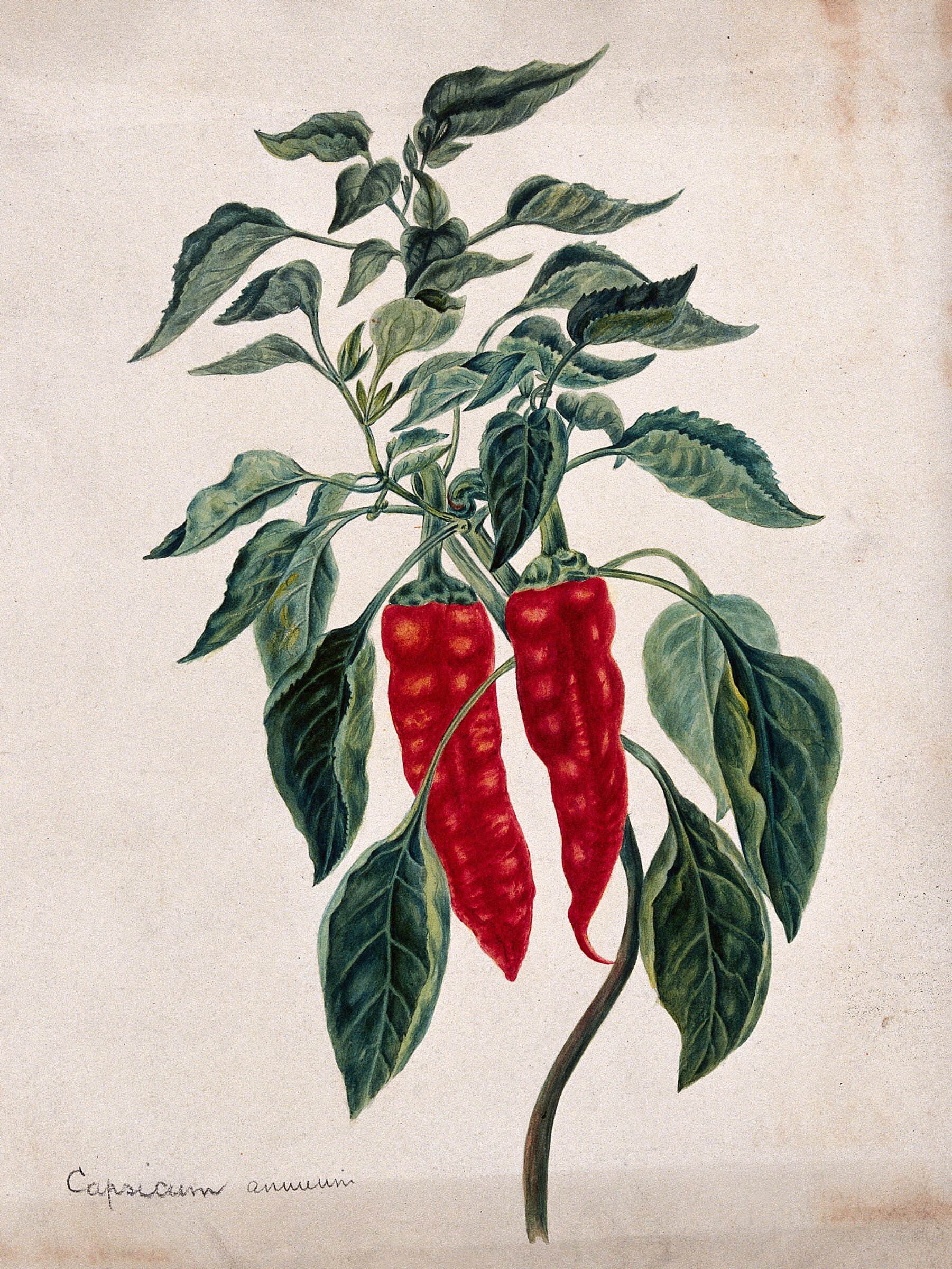
A Pepper’s Botanical Identity
Jalapeño and bell pepper are familiar kitchen names; a species name opens their botanical portrait. Kew accepts Capsicum annuum in the Solanaceae family. Its descriptions of white flowers and a berry-type fruit give that identity features we can look for.
NMSU’s Chile Pepper Institute introduces five domesticated Capsicum species: annuum, chinense, frutescens, baccatum and pubescens. Species names offer a starting point for following relationships among peppers. The name Capsicum annuum also appears in the Capsicum section on pages 188–189 of the first volume of Carl Linnaeus’s Species Plantarum, published in 1753; the species’ naming record is tied specifically to page 188.
From Flower To Fruit Section
A long, narrow fruit and a round, lobed one do not create the same outline. The variation in shape, size and colour described by Kew also presents the botanical artist with choices: where to interrupt a contour, which detail to enlarge and how a section might reveal the interior.
At close range, the point where the fruit stalk attaches, the green structure surrounding the flower and the outline of the fruit wall become separate details. Looking at an exterior and a section together brings the tissues beneath the surface into the portrait.
The botanical name for the structure surrounding the flower is the calyx. Kew’s morphological description notes that it remains on the fruit; the whitish flowers usually occur singly in a leaf or branch axil. Following the petals and the calyx separately makes it easier to see which structure persists as the flower gives way to fruit.
Sources For This Section
Reading A Collection Drawing
One drawing may enlarge the flower while giving less space to a leaf edge; another may accommodate the whole plant. Paper, paint and annotation join those choices. The Rijksmuseum pepper study lets us follow the plant’s details and the making of the picture on the same surface.
The Rijksmuseum dates Peperplant (Capsicum annuum) to 1596–1610. Its maker field names Anselmus Boëtius de Boodt and Elias Verhulst. The work on paper combines watercolour, opaque paint, black chalk and writing. Its object number is RP-T-BR-2017-1-11-22.
The Rijksmuseum records three names written on the work: ‘indiaensche Peper’, ‘Piper Brasilicum’ and ‘Poivre du Brésil’. Dutch, Latin and French annotations on the same sheet make the plant’s names part of the collection object alongside its form. The current catalogue title, Capsicum annuum, supplies a botanical identity alongside these historical names.
The date range and the two catalogued makers locate a particular historical sheet. On its surface, two kinds of paint can work differently: the paper’s brightness contributes to transparent watercolour, while opaque paint can cover the support. A pepper’s curve may become distinct through these layers as well as through its drawn contour.
Technique, Album And Unrecorded Information
Pepper study 22735i in the Wellcome Collection is catalogued as a watercolour. The collection note places it in an album of Japanese herb and vegetable watercolours; the visible record supplies neither an artist nor a date. It is a separate object from the fruiting-branch study 21891i used at the opening of this article.
The album is described as Japanese watercolours, but the language field for 22735i lists Chinese. A pictorial tradition and the language of a page’s writing need not be collapsed into one assumption about origin. The artist and date remain unspecified in the visible record.
Kew explains that its illustration collection serves researchers alongside herbarium specimens. Its history of botanical illustration also discusses the role of sections, annotations and selected details in producing knowledge. A drawing’s scientific value becomes clearer through the structures it shows and the records read with it.
Returning to the fruit, we can notice what the drawing has made especially available: a persistent calyx, the fruit wall in section or the arrangement of seeds. A drawing need not say everything about a plant at once. It gives us time with the detail it has chosen.
Culinary Names And Species Names
NMSU’s Chile Pepper Institute places bell peppers, jalapeños and poblanos within C. annuum. Habanero and Scotch bonnet belong to C. chinense. Ingredients with different culinary names can therefore meet under the same botanical species.
| Layer | Example | Role In The Portrait |
|---|---|---|
| Family | Solanaceae | Broad botanical relationship |
| Genus | Capsicum | The name grouping species |
| Species | Capsicum annuum | A specific botanical identity |
| Culinary name | Jalapeño or poblano | The ingredient’s name in a kitchen vocabulary |
Different Views In One Portrait
A jalapeño named on a sauce label can lead us back to C. annuum; in a botanical portrait, that name acquires a flower, calyx and fruit. Looking at the whole plant and looking into a section are different acts of attention. The portrait gains depth through those small shifts: silhouette, calyx beside the stalk, then tissue beneath the surface.
Sources And Further Reading
- Kew Science · Botanical record of Capsicum annuum
Reading area: Capsicum annuum: accepted taxon, family and morphology; the Flora of Tropical East Africa description covers usually solitary axillary flowers and the calyx persisting in fruit.
Accessed:
- NMSU Chile Pepper Institute · The Story of Chile Peppers
Reading area: Cultivated Capsicum species and familiar culinary examples.
Accessed:
- Linnaeus · Species Plantarum, vol. 1, 1753
Reading area: 1753, volume 1: the Capsicum section on pp. 188–189; the naming record for Capsicum annuum on p. 188.
Accessed:
- Peperplant (Capsicum annuum), RP-T-BR-2017-1-11-22
Reading area: RP-T-BR-2017-1-11-22: makers, 1596–1610, historical titles on the object, Dutch/Latin/French annotations, and materials and technique.
Accessed:
- A chilli pepper (Capsicum annum) and a separate leafy stem. Watercolour. — 22735i
Reading area: 22735i: watercolour technique, the note identifying an album of Japanese herb and vegetable watercolours, and the Chinese language field; no artist or date is supplied in the visible record.
Accessed:
- Illustrations and Artefacts Collections
Reading area: Illustrations used alongside herbarium specimens as a reference tool
Accessed:
- Worth a thousand words: The hidden histories of botanical illustrations
Reading area: Artists select details; interpretation is contextually bounded
Accessed:
- The Metropolitan Museum of Art · Watercolor, 2020
Reading area: Transparent watercolour and its paper support; the covering properties of bodycolour/gouache.
Accessed: