History And Thought
The Chili Pepper’s Journey: From American Traces To European Pages
Begin the pepper’s journey before the ship, with a tiny residue on a grinding stone. Archaeological traces in the Americas reveal Capsicum as a processed ingredient long before European encounters. Later, ají enters a voyage account, a red fruit appears in a European kitchen painting, and Arnavut biberi reaches recipe pages in Istanbul. The journey cannot be contained in a single arrival date.
The Americas: Traces Of A Processed Ingredient
In 2007, Linda Perry and colleagues reported starch microfossils distinctive to Capsicum at seven archaeological sites from the Bahamas to southern Peru. The evidence spans approximately 6,000 years before the present through European contact. Residues on grinding stones and vessels show how pepper can be investigated as a processed ingredient as well as a gathered plant.
A fruit may disappear while its starch grains survive. Using modern peppers as a reference collection, Perry and colleagues examined grain size, flattened lens shape and central depression. These small forms on a tool made it possible to investigate pepper’s past beyond surviving whole fruits.
Kraft and colleagues’ 2014 research approached the origin of domesticated Capsicum annuum through four lines of evidence: genetics, archaeology, linguistics and ecology. Combined models identified northeastern Mexico, central-eastern Mexico, or both as possible regions. This geographical framework is broader than a certain point of origin in one valley. The research concerns C. annuum; the domestication of all Capsicum species is not reduced to one event.
New evidence continues to reshape the geographical picture. In 2024, Chiou and colleagues combined modern and archaeological pepper seeds, settlement distributions and ecological models of past climates. They identified the Yucatán Peninsula and southern coastal Guerrero as areas conducive to early encounters between people and wild peppers. Their view of domestication as a process spread across places and times brings the conditions that preserved remains into conversation with the environments where the plant could once grow.
Ají: Describing An Unfamiliar Ingredient Through A Familiar Name
The original manuscript of Columbus’ first voyage diary is lost. Its known text is read through Las Casas’ summary. In the entry for 15 January 1493, ají is compared with pimienta, a spice familiar to European readers. An unfamiliar ingredient is being described through the vocabulary of a known spice.
In Chanca’s letter of 1494, agi adds pungency to bread, fish and bird dishes. Voyage accounts describe European observers encountering an existing cuisine. Naming the ingredient did not begin with them: Nahuatl chilli and Taíno-derived ají carry an Indigenous American world of names.
A Kitchen Painting And A Natural-History Page
The National Gallery identifies a wrinkled red chilli in the foreground of Velázquez’s Christ in the House of Martha and Mary, probably painted in 1618. Among garlic, fish and eggs, this small object places pepper within food preparation. Its relationships are read from the details of one scene.
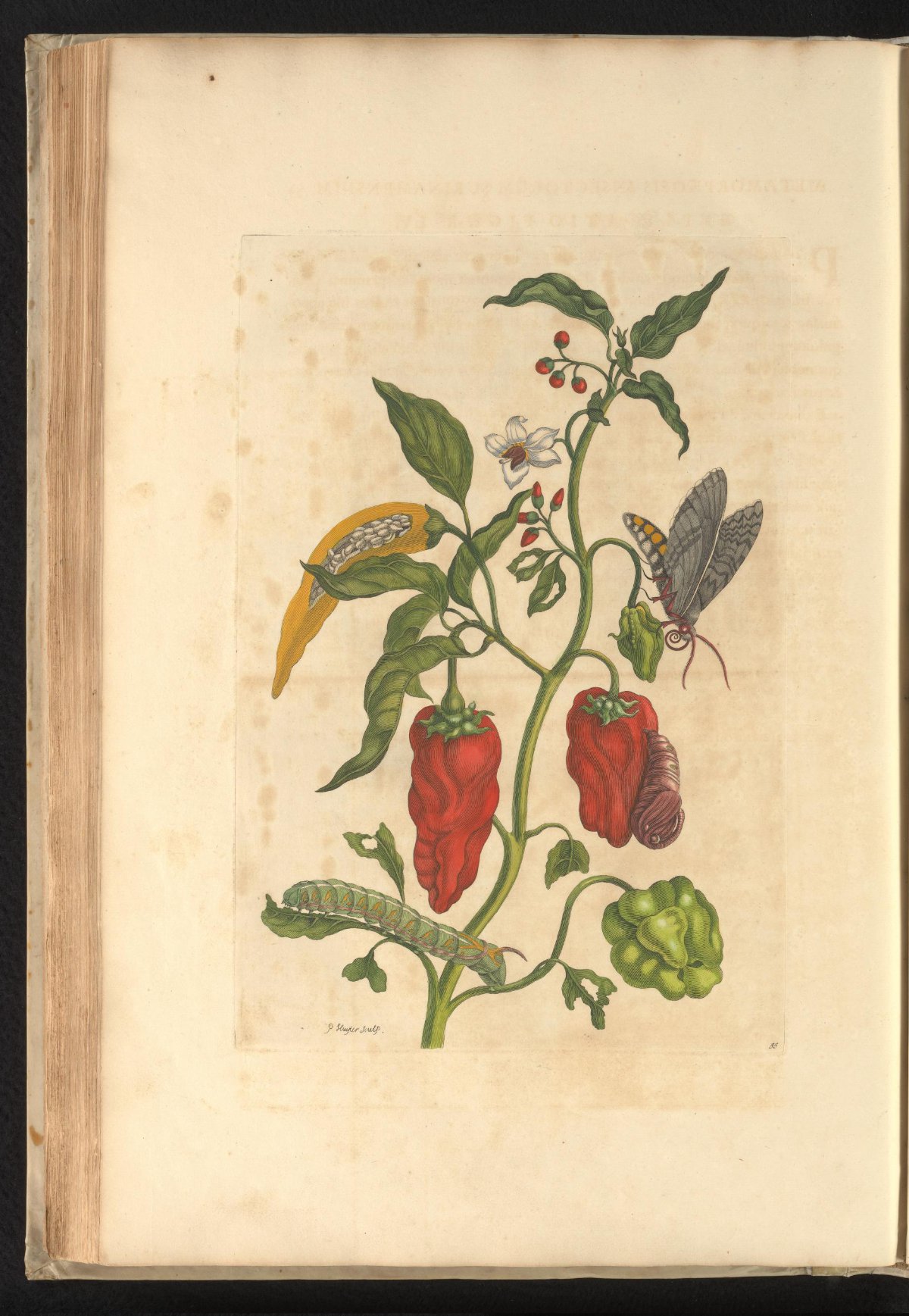
On a Rijksmuseum sheet dated 1705, pepper appears alongside a butterfly, caterpillar and pupa. Pieter Sluyter’s hand-coloured engraving after Maria Sibylla Merian’s drawing belongs to Metamorphosis insectorum Surinamensium, her book on Surinam. Pepper participates in food preparation in Velázquez’s kitchen; here it becomes the subject of attention to relationships between plants and insects. The same ingredient belongs to two different forms of observation.
Istanbul: The Time Between An Early Recipe And Wider Adoption
Özge Samancı’s 2019 research traces red pepper in an eighteenth-century pickle recipe. She notes its sparse appearance as Arnavut biberi in the 1844 Melceü’t-Tabbâhîn. The wider adoption of New World products in Istanbul, especially during the nineteenth century, is a separate process following those early traces.
At the Istanbul stop, the journey slows. Time lies between appearing in a pickle recipe and becoming an everyday ingredient. Sparse use in the 1844 book makes that interval tangible. The story of a pepper once leaving a trace on a grinding stone, then appearing in a painter’s kitchen, continues through the place it gradually finds at another table.
- The pepper atlas: place, name and kitchen
- A botanical portrait of the pepper
- Ingredients in still life: Peale and Meléndez
Sources For This Section
Sources And Further Reading
- Perry and colleagues · Starch fossils and the domestication and dispersal of chili peppers, Science 2007
Reading area: Capsicum starch microfossils from seven sites between the Bahamas and southern Peru, about 6000 years before present through European contact. Original paper p. 986: modern comparison and grain size, lenticular shape and central depression. [Full text](https://repository.si.edu/bitstreams/fb7cb6a2-7f94-493b-8805-a4f8f9f0588b/download).
Accessed:
- Kraft and colleagues · Multiple lines of evidence for the origin of domesticated chili pepper, PNAS 2014
Reading area: Four lines of evidence for domesticated C. annuum; northeastern and central-eastern Mexico evaluated separately or together as possible regions of origin.
Accessed:
- Navarrete (ed.) · Colección de los viages y descubrimientos, vol. I, 1825
Reading area: Navarrete 1825, volume I, page 286: diary-summary entry of 15 January 1493 comparing ají and pimienta, transmitted through Las Casas’ summary.
Accessed:
- The letter of Dr Diego Alvarez Chanca, 1494 · Fernández de Ybarra translation, 1907
Reading area: Fernández de Ybarra 1907 translation, Smithsonian Miscellaneous Collections 48, p.455: agi seasoning bread and adding pungency to fish and bird dishes.
Accessed:
- UNAM · Gran Diccionario Náhuatl: chilli
Reading area: Molina 1571, Molina_2, fol. 21r: chilli is explained as axi o pimienta de las indias. [Direct entry](https://gdn.iib.unam.mx/diccionario/chilli/37711).
Accessed:
- RAE / ASALE · ají
Reading area: Taíno origin.
Accessed:
- National Gallery · Velázquez, Christ in the House of Martha and Mary, NG1375
Reading area: The foreground table of the painting probably dated 1618; the museum identifies a wrinkled red chilli among garlic, fish and eggs.
Accessed:
- Rijksmuseum · Pieter Sluyter, Spaanse peper met vlinder, rups en pop, 1705
Reading area: 1705 engraving; Pieter Sluyter as printmaker after a drawing by Maria Sibylla Merian, from the book on Surinam.
Accessed:
- Özge Samancı · New World flavours in Istanbul cuisine: tomato, pepper, 2019
Reading area: Samancı 2019, pp. 88–89: an 18th-century red-pepper pickle, Arnavut biberi in the 1844 cookbook and wider use in the 19th century. Page 88, note 5: gardens and produce in 1854 palace kitchen ledgers (BOA, Cevdet Saray, no. 257), as reported by the researcher.
Accessed:
- Chiou and colleagues · Cultural and chronological context of pepper domestication in Mexico, PNAS 2024
Reading area: 121(47), e2413764121; Abstract, discussion of preservation, and Results/Discussion. Modern and archaeological seeds, ecological models, and proposed early encounter areas in Yucatán and southern coastal Guerrero.
Accessed: