Table And Design
Peppers In Still Life: Renoir, Demuth And Pissarro
Looking again at ingredients and the table through the form, surface and surrounding space of peppers in three works of art.

Looking Again At An Ingredient
In a kitchen, a pepper usually arrives with a task attached: wash it, slice it, roast it. Still life pauses that sequence. The direction of a stem, a fold in the skin and a shadow on the table invite a different kind of attention.
In the three works considered here, by Renoir, Charles Demuth and Camille Pissarro, the pepper takes on different roles. It lends colour and weight to a group of fruit, emerges against open paper, or becomes a way to consider how different surfaces meet the light.
Renoir: The Weight Of Colour
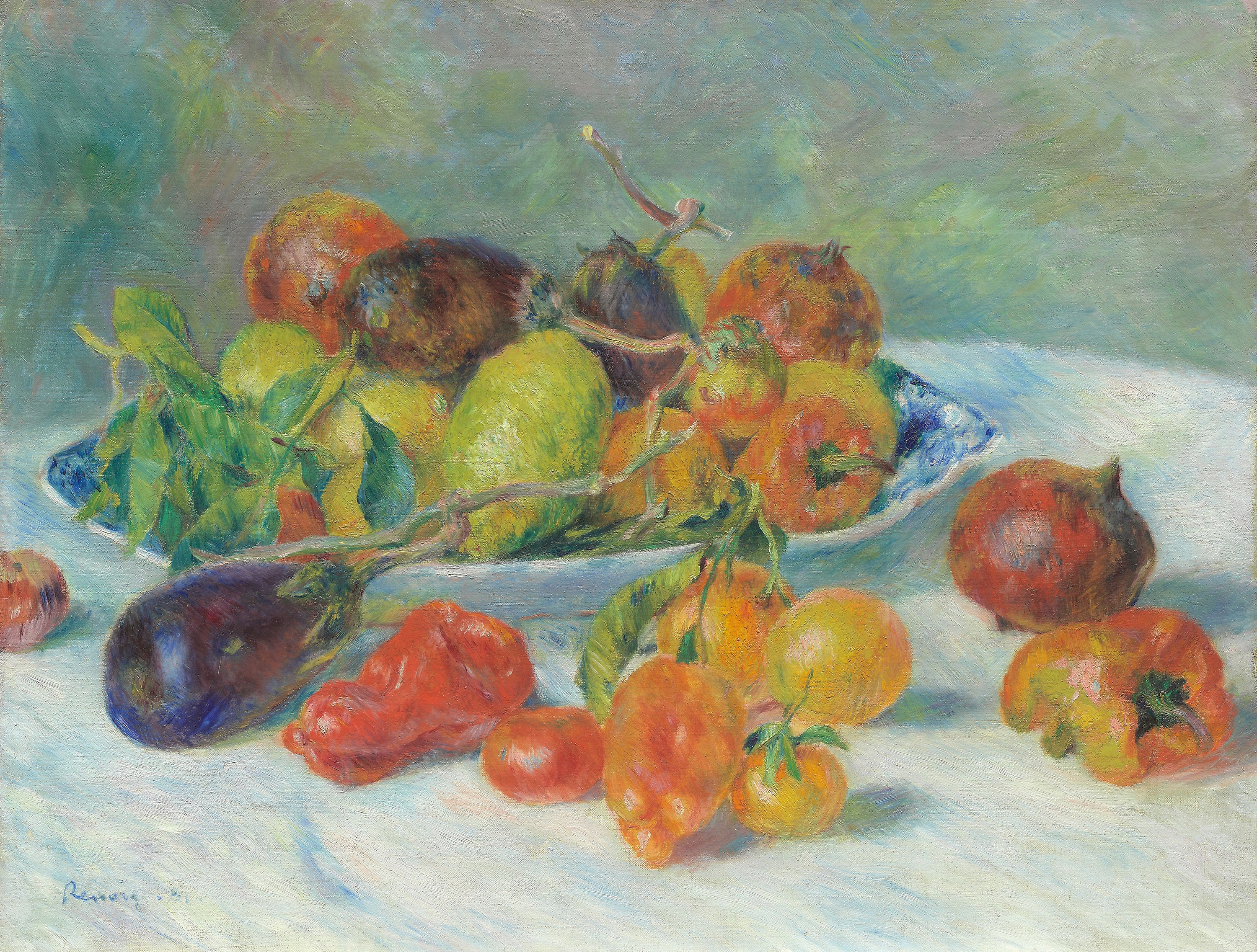
In Renoir’s Fruits of the Midi of 1881, red and yellow peppers share a pale tablecloth with eggplants and other fruit.
The peppers in the foreground are more than smooth patches of colour. Their swelling and folded forms set a rhythm beside ingredients that are rounder or longer. The pale cloth defines the dark eggplant while giving the warmer colours room to sit together. Asking which ingredient looks heavy and which looks light offers a simple way into the arrangement.
Sources For This Section
Demuth: Light Left In The Paper
Charles Demuth made Eggplant and Green Pepper in 1925, using watercolor and graphite. In the work held by the Saint Louis Art Museum, a green pepper, a purple eggplant and a vase of flowers meet in a vertical arrangement.
White does not behave as a background that fills every gap. Paper left visible between the washes opens spaces around the objects. The pepper’s divided green surface and the dark body of the eggplant make one another more distinct. Beside the weight Renoir gathers on his cloth, Demuth suggests how the same familiar ingredients can inhabit a more open arrangement.
Sources For This Section
Pissarro: One Light, Different Surfaces
The Dallas Museum of Art’s exhibition label for Camille Pissarro’s 1899 oil painting Still Life with Spanish Pepper offers another question: how pepper, glass, ceramic and textile reflect light differently. The label records the work as a loan from the Pauline Allen Gill Foundation.
This approach asks us to consider more than the colour of a pepper. A transparent glass, a matte bowl or a textured cloth placed beside it changes how we see it. Light finding a different response in each surface reminds us that variety at a table cannot be measured only by the number of ingredients.
Sources For This Section
A Small Comparison Between Three Works
Thinking about these works together does not require a single correct arrangement. With Renoir, we can follow the weight that forms lend one another; with Demuth, the effect of gaps and uncovered paper; with Pissarro, the question of surface and reflection suggested by the museum’s label.
Our first thought on seeing a pepper may be its taste. Later, the angle of its stem, the light on its skin or the space beside another object may come forward. The ingredient stays the same while our attention changes. That possibility is one of still life’s quiet contributions to everyday looking.
Returning To The Table
At the table, this attention helps us notice the space at the edge of a plate, the position of a small bowl or the weight of a bottle in an arrangement. Food is still there to be eaten and sauce to be shared.
The red of a bottle of hot sauce looks different against a pale plate and a dark cloth. Opening its cap, taking a little on a spoon and setting it beside a bite changes the arrangement again. What we can carry from still life to the table is a habit of looking a little longer at the ingredients in front of us.
Sources And Further Reading
- Art Institute of Chicago — Renoir, Fruits of the Midi, 1881
Reading area: Date, medium, accession1933.1176 and explicit identification of peppers in the painting.
Accessed:
- Saint Louis Art Museum — Charles Demuth, Eggplant and Green Pepper
Reading area: 1925 watercolor and graphite, accession2:1948, and the museum’s explicit identification of pepper and eggplant.
Accessed:
- Dallas Museum of Art — The Impressionist Revolution exhibition labels
Reading area: Still Life with Spanish Pepper,1899: identification, medium, lender and the museum’s material/light interpretation.
Accessed: